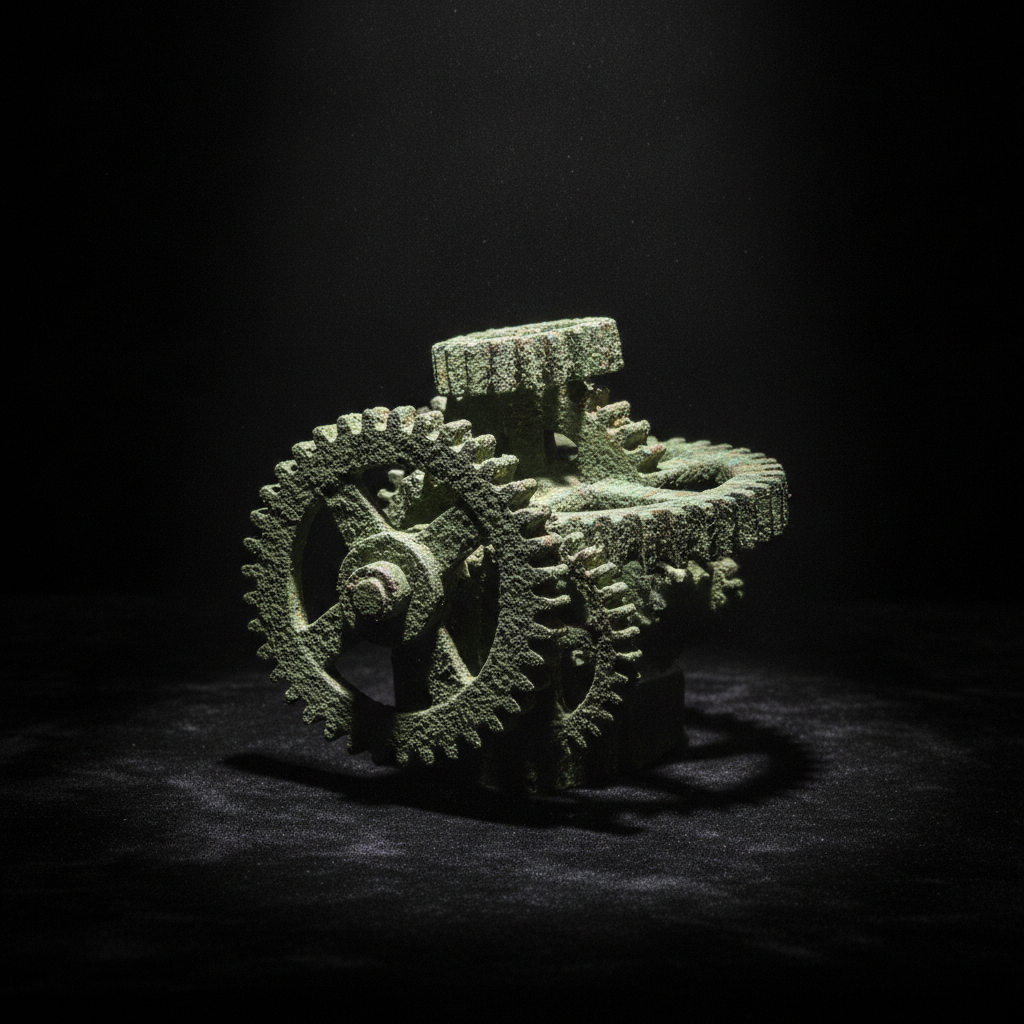
The Machine That Shouldn't Exist: Secrets of the Antikythera Mechanism
The first man to see the wreck came up screaming. In the spring of 1900, a Greek sponge diver named Elias Stadiatis, working with a crew out of the island of Symi, descended some 45 meters off the tiny island of Antikythera and surfaced babbling about a heap of dead men and horses rotting on the seabed. His captain, Dimitrios Kontos, thought the depth had addled his mind, dove himself, and came back holding the bronze arm of a statue. The corpses were sculpture, the cargo of a Roman-era ship that had gone down around 60 BC laden with the plundered art of the Greek world, most likely bound from the eastern Aegean toward Italy when it foundered against Antikythera's cliffs. Over the following year, in a salvage carried out in heavy diving suits at the ragged edge of what the human body can survive, the crew brought up marble gods and bronze masterpieces: the Youth of Antikythera, a bronze ephebe of around 340 BC, the brooding head known as the Philosopher, and some three dozen marble figures of Hercules, Odysseus and Apollo, one of which slipped from the divers' grasp and was lost again to the deep. The work maimed the men who did it: one diver died of the bends and two were left paralyzed, among the first recorded casualties of a science of decompression that barely existed in 1900. Coins later recovered from the wreck, struck in Pergamon and Ephesus in the decades before the ship went down, would help fix the disaster to the middle of the first century BC.
Among the marble, almost unnoticed, came up one corroded lump of bronze the size of a shoebox, which was shipped to the National Archaeological Museum in Athens and set aside. On May 17, 1902, the archaeologist Valerios Stais noticed something in the split-open lump that had no business being there: a precisely cut gearwheel, engraved with Greek letters. Nothing of comparable mechanical complexity appears again in the surviving record for well over a thousand years, until the astronomical clocks of medieval Europe. The device - 82 surviving fragments holding about 30 gears, perhaps a third of the original machine - is now dated to roughly the second or first century BC and known as the Antikythera Mechanism, the oldest geared computer ever found. For half a century after Stais it was mostly a curiosity that embarrassed the experts, too advanced to fit the story archaeology told about Greek technology, and easier to ignore than to explain.
Housed in a wooden case no larger than a thick book, its bronze front and back crowded with dials, the machine came alive when a small hand crank set its pointers in motion. A front dial tracked the Sun and Moon through the zodiac and showed the Moon's phase with a little rotating silver-and-black ball; spiral dials on the back followed the 19-year Metonic calendar and the 223-month Saros cycle, letting the machine predict eclipses years in advance and even name the likely hour and color of each. A subsidiary dial counted down the four-year cycle to the games and named them - Olympia, Nemea, the Isthmus, Delphi - alongside the obscure little Naa festival held far off at Dodona in northwestern Greece and a contest linked to Rhodes, geographic clues archaeologists still argue over. And an ingenious pin-and-slot coupling, one gear riding slightly off-center on another, reproduced the Moon's varying speed across the sky, the lunar theory of the astronomer Hipparchus worked out on paper and then rendered in turning metal.
We know all this because of a century of stubborn decipherment. The physicist Derek de Solla Price spent decades on the fragments and published his landmark study, Gears from the Greeks, in 1974, the first to reconstruct the gear trains from X-ray shadows. In 2005 an international team hauled an eight-ton microfocus X-ray scanner to Athens; the interior images, published in Nature in 2006 by Tony Freeth and his colleagues, revealed thousands of hidden Greek characters - a user's manual engraved inside the case - and the exact tooth counts of the gears, some nested one behind another in ways no one had guessed. A companion study in 2008 traced the spiral back dials, decoded the Saros eclipse predictor, and first made out those engraved game names that place the mechanism's world in the Greek-speaking heartland rather than in Egypt or Babylon. In 2021 Freeth's team at University College London reconstructed the front Cosmos display: a miniature planetarium showing the five planets known to antiquity, encoding a 462-year cycle for Venus and a 442-year cycle for Saturn.
The machine has not stopped talking. In 2024, two gravitational-wave researchers at the University of Glasgow, Graham Woan and Joseph Bayley, borrowed the statistical tools they use to hunt black holes and turned them on the tiny holes drilled around the mechanism's broken calendar ring. Their Bayesian analysis concluded the full ring had almost certainly held 354 or 355 holes - a lunar calendar, not the 365-day Egyptian one - with a best estimate of 355.24, drilled with an average positional error of about a third of a millimeter. In 2025, the engineers Esteban Szigety and Gustavo Arenas of Argentina's National University of Mar del Plata simulated the gear train with the triangular tooth shapes and manufacturing errors measured in the surviving fragments and reached an awkward result: the mechanism would likely have jammed or slipped its teeth before completing a single year's turn, perhaps seizing every few months.
When Cousteau's divers returned to the wreck in 1976, invited by the Greek government, they raised nearly 300 more objects - coins that helped pin the date, bronze and marble fragments, jewelry, and the scattered human bones of the ship's own drowned passengers - but not a single additional gear. Later expeditions, returning from 2012 onward with rebreathers and underwater robots, have kept combing the same seabed and have never yet turned up a twin.
Conclusions and Open Questions
The device raises a question its own gears cannot settle: would it even turn? The 2025 simulation suggests it would have jammed, which leaves two possibilities. Either it never truly worked as a smooth instrument, or corrosion over two millennia has warped the fragments and the ancient errors were smaller than anything we can now measure in a lump of sea-eaten bronze. A machine of this sophistication that could not run would be an absurdity, yet no one has fully explained how its maker cut teeth fine enough to escape one. That two teams reaching for the sharpest tools of modern physics still disagree over whether the thing would even rotate is, in its way, the most Antikythera fact of all.
Then there is the question of who built it. The mechanism carries no maker's name, nothing but its engraved instructions. Cicero, writing decades after the shipwreck, described a bronze sphere made by Archimedes that modeled the movements of Sun, Moon and planets, carried off from Syracuse as war booty when the city fell in 212 BC, and a similar device built by his own teacher, Posidonius of Rhodes. Rhodes has long been the favored suspect: a great center of astronomy and the home of Hipparchus, whose lunar theory lives inside the machine. But the month names engraved on the calendar dial are Corinthian, pointing instead toward Corinth or its western colonies, among them Syracuse, the city of Archimedes himself, who had been dead a full century by the machine's likely date. The historian Alexander Jones and Tony Freeth lean on those Corinthian names to argue for a western, Syracusan pedigree in the tradition of Archimedes; others answer that the astronomy inside is unmistakably Rhodian, the mathematics of Hipparchus, and that a device could be built in one place using calendar conventions borrowed from another. Some read the dense engraved text as a teaching instrument; others as a luxury commission for a wealthy Roman or Greek. The evidence points confidently in two directions at once and settles in neither.
The deeper mystery is the silence that follows. If Cicero could mention such devices almost in passing, they were admired but perhaps not unique, so where are all the others? Derek de Solla Price argued that we possess this one only by an accident of the sea: bronze was far too valuable to leave lying about, and broken or obsolete machines were melted down and recast, generation after generation, so that only a shipwreck could hide a mechanism from the recyclers. Against that, nothing documented supports whole workshops of geared wonders - no second mechanism, no workshop, no tools, no half-finished gear has ever been found anywhere - which leaves open the possibility that the machine was a solitary peak, the once-in-a-civilization meeting of a single brilliant theorist and a single impossibly skilled metalworker, a collaboration that produced one marvel and was never repeated.
What the mechanism finally insists is that human ingenuity is not a steady climb but something that can be won, lost, and won again - that a civilization could reach this exact pitch of mechanical genius, and that the knowledge could then vanish so completely that the world needed fourteen centuries to build its way back. Of all the geared wonders that may once have turned, we know a single specimen: the one the sea was cruel enough to sink, and kind enough to keep.