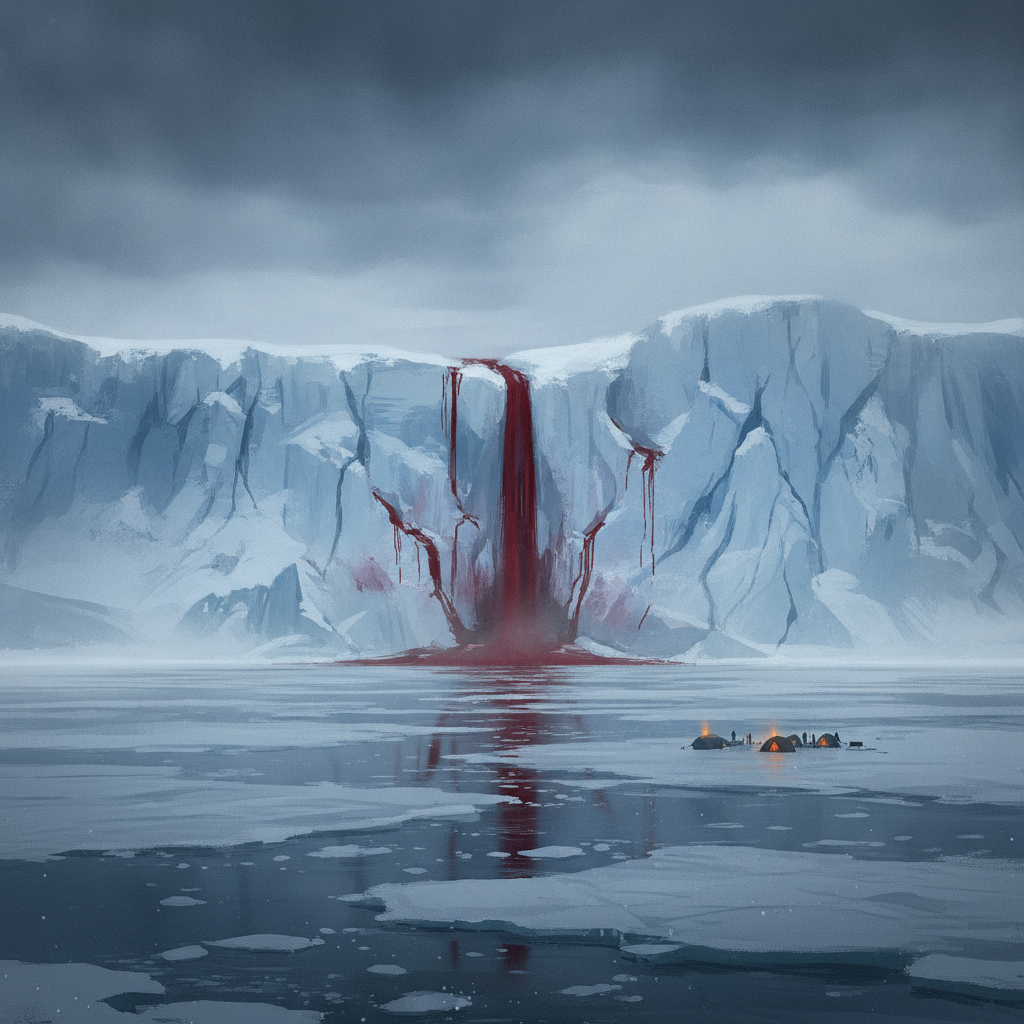
Blood Falls: The Antarctic Glacier That Bleeds, and the Century It Took to Explain
Stand at the foot of Taylor Glacier, in the frozen desert of Antarctica's McMurdo Dry Valleys, and for a moment your eyes tell you something has gone horribly wrong. The Dry Valleys are among the driest, coldest, most lifeless-looking places on the planet, a landscape of bare rock and blue-white ice where it has scarcely rained for two million years. And out of a fissure in the wall of that ancient ice, a stream the colour of dried blood spills down the pale face and pools on the frozen surface of Lake Bonney. It looks, unmistakably, like a wound. It looks like the glacier is bleeding. There is no wound, and there is no blood. And yet for more than a hundred years, nobody could say with confidence what the red water actually was.
The falls were found in 1911 by the Australian geologist Thomas Griffith Taylor, who was mapping the valley that now carries his name during Robert Falcon Scott's Terra Nova expedition, the same expedition from which Scott and four companions would never return. Taylor looked at the red stain and guessed that the colour came from red algae growing in the ice. It was a sensible first thought for a careful naturalist of his era, and it was wrong. The algae idea held for decades, partly because the real source lay somewhere no one could reach, and partly because the truth would turn out to be stranger than any living stain.
The puzzle was really two questions. What turns the water red? And where does that water come from, sealed as it seems to be inside a glacier that barely melts, in a place far too cold for liquid water to exist?
The red, it emerged, is not life but rust. Far below the ice sits an ancient reservoir of brine, water so heavy with salt that it stays liquid at temperatures which freeze ordinary water solid, and so loaded with dissolved iron that no one would call it drinkable. Down in that dark, airless reservoir the brine runs clear as tap water. The instant it reaches the surface and meets oxygen for the first time in perhaps a million years, the dissolved iron begins to oxidise, and within seconds the flow flushes red. Blood Falls, in the plainest terms, is the colour of iron rusting before your eyes, the same reaction that stains an old nail, staged on the scale of a waterfall. The salt is what keeps the reservoir liquid; strip it away and the whole hidden pool would freeze into the glacier around it.
In 2023 a team including the Johns Hopkins materials scientist Ken Livi and the microbiologist Jill Mikucki put samples under a transmission electron microscope, a far more powerful instrument than anything used before, and found what earlier work had missed. The red comes from countless iron-rich nanospheres, particles about a hundredth the size of a single red blood cell, carrying not only iron but silicon, calcium, aluminium and sodium. Crucially, they are not crystals. "In order to be a mineral, atoms must be arranged in a very specific, crystalline structure," Livi explained; because these tiny spheres lack any such ordered structure, standard techniques for identifying minerals, such as X-ray diffraction, had never registered them. They were there all along, invisible to the very tools sent to look for them.
The second question, the hidden plumbing, held out until 2017. The brine had to travel from somewhere deep within or beneath the ice all the way to the glacier's snout, and for a century that route was invisible. A team led by Jessica Badgeley, then an undergraduate at Colorado College, working with the University of Alaska Fairbanks glaciologist Erin Pettit, used radio-echo sounding, a radar that sees through ice, dragging antennae across the glacier in grid patterns to picture what lay beneath, the way a bat maps a room by echoes. The survey crossed the ice in careful transects, building the picture one line at a time. It was the salt itself, sharpening the contrast against fresh ice, that made the hidden network detectable at all. They traced cracks and channels carrying pressurised brine roughly ninety metres through solid, sub-zero ice to the point where it emerges, and tied it to a reservoir that may have been sealed for more than a million years, ever since a pocket of seawater was trapped and cut off by the slowly advancing glacier. A cold glacier, textbooks had long insisted, is frozen through and cannot hold liquid water moving inside it. Blood Falls says otherwise.
And here the story turns genuinely strange. In a 2009 paper in the journal Science, Mikucki and her colleagues had shown that this buried brine is not sterile. It holds a thriving community of microbes, at least seventeen distinct types, living in perpetual darkness with almost no oxygen, powering themselves not by breathing air but by cycling iron and sulphur compounds, using dissolved iron in a way few organisms on the surface ever do. They have gone on doing this, in cold and salty blackness, sealed off from the sun and the atmosphere, for something on the order of a million and a half years. No sunlight has reached them since the reservoir was sealed, and no breath of open air; their entire economy runs on rock, iron and salt water. The reservoir is, in effect, a time capsule, and the life inside it has been running on its own quiet chemistry since long before our species existed.
So the century-old riddle of the bleeding glacier now has an answer in three parts. The colour is oxidising iron, refined in 2023 down to amorphous nanospheres no earlier instrument could see. The water is ancient brine, its hidden channels mapped by radar in 2017. And the reservoir that feeds it is alive, home to microbes that have survived in isolation for over a million years. A glacier that first looked like a curiosity, and then like a wound, turned out to be one of the strangest living systems on Earth.
Conclusions and Open Questions
The colour is solved and the plumbing is mapped, but "solved" is a generous word for the life below. How does an entire ecosystem feed itself, cut off from sunlight and air, for a million years or more, without collapsing? What exactly are those organisms living on, and how fast, or how impossibly slowly, do they live? Have they been evolving in isolation all that time, drifting away from their marine cousins into something genuinely new? The microbes are confirmed and the outline of how they earn a living is sketched, but the full ledger of energy in and energy out that would explain how life balances its books in such a place remains open.
There are competing ways to read what Blood Falls means. One view, held by many planetary scientists, is that it is essentially a rehearsal for the search for life beyond Earth. The strength of this reading is a real and specific analogy: a cold, dark, salty, iron-rich, oxygen-poor world that nonetheless sustains life is exactly the kind of place we suspect might exist elsewhere. Its weakness, as those scientists themselves admit, is that an analogy is not a discovery; nothing at Blood Falls proves there is life anywhere but here. The worlds this hope is pinned on are specific: the buried ocean of Jupiter's moon Europa; the salty plumes Saturn's moon Enceladus jets into space; the frozen, iron-rich ground of Mars. Each is cold, dark and salty in ways that rhyme with the reservoir under Taylor Glacier. But rhyme is not identity: Europa's ocean may be a hundred kilometres deep and utterly unlike a thin Antarctic brine pocket, and Mars may have gone sterile a billion years before anything like Blood Falls could form.
A second, more cautious reading holds that the deepest lesson is not astrobiological at all but methodological, and here Livi's own words point the way. If iron nanospheres could hide for a century beneath the most scrutinised red stain in Antarctica, invisible to the instruments we trusted, then our instruments may be misleading us elsewhere too. Livi noted that the equipment carried by rovers on other planets cannot fully characterise materials of exactly this kind, the non-crystalline, nanoscale particles that standard mineral-hunting methods pass over. One theory holds that the two readings are not really rivals but two halves of the same warning: a rover rolling up to a Martian equivalent of Blood Falls might report "iron oxides" and move on, exactly as a century of Earth-bound science did here, and miss both the amorphous nanospheres and whatever, if anything, was living in the water. That remains speculation, not fact.
What lingers is subtler than a solved mystery. The microbial ledger is still not balanced, the full plumbing is mapped only in outline, and the leap to other worlds is still only a leap. A century of getting one small waterfall wrong, algae, then iron, then iron of a kind no one had thought to look for, is a lasting lesson in how long the obvious can go on hiding the true.