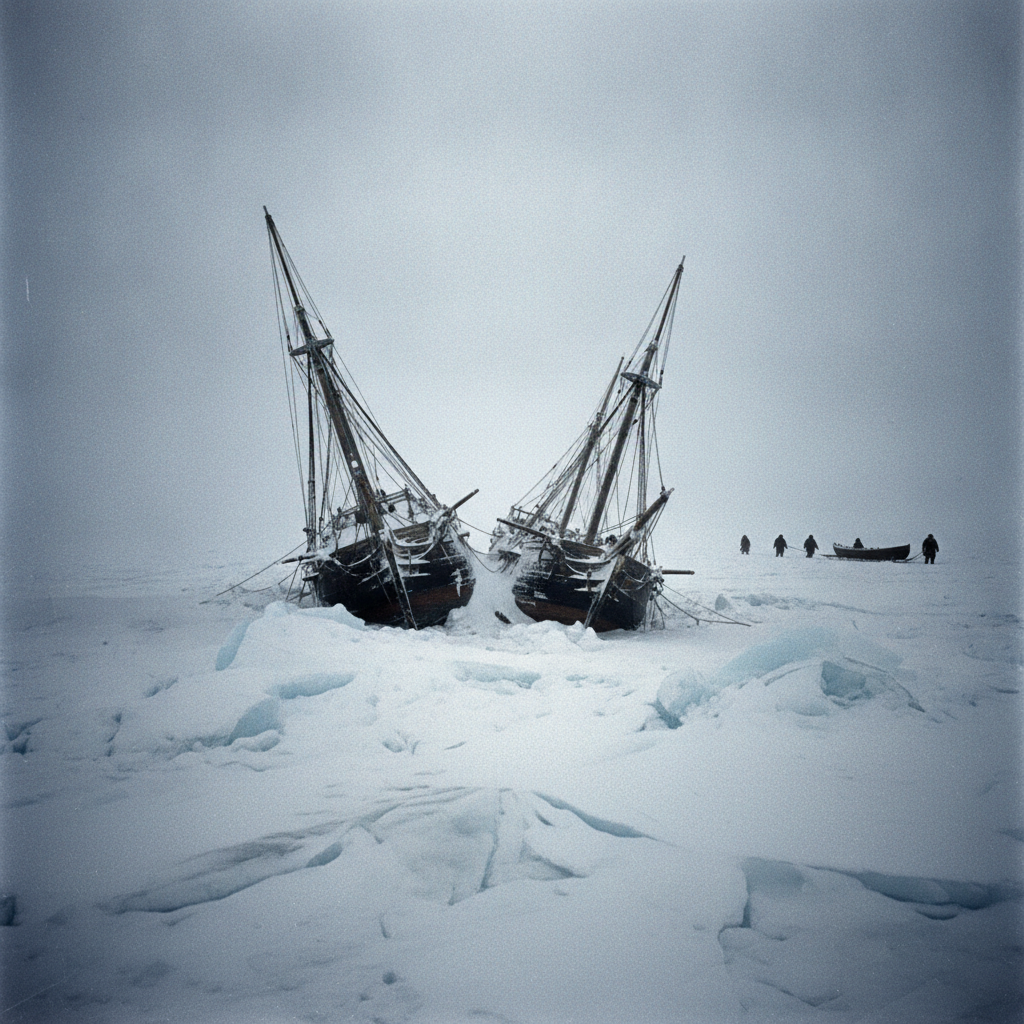
The Note in the Cairn: 129 Men Who Walked South and Never Arrived
The last Europeans to see them were whalers. In late July 1845, in Baffin Bay, the crews of the Prince of Wales and the Enterprise came upon two Royal Navy ships moored to an iceberg, waiting for the pack to loosen so they could push west into Lancaster Sound. Officers rowed across to visit. There was talk of the three years of provisions in the hold, of the engines fitted below decks, of a commander who expected to be home long before the food ran out. Then the ice moved, the ships parted, and the expedition sailed out of the written record.
HMS Erebus and HMS Terror had left Greenhithe, in Kent, on 19 May 1845 to find the Northwest Passage. They were bomb vessels, built heavy to absorb the recoil of mortars, which made them promising candidates for ice. The Admiralty rebuilt them for the Arctic: iron plating on the bows, screw propellers that could be hoisted clear of danger, steam heating for the living quarters, converted railway locomotive engines, libraries of more than a thousand volumes, and tens of thousands of tins of preserved food. Sir John Franklin, fifty-nine years old and on his fourth Arctic voyage, commanded 134 men. Five were discharged as unfit at Disko Bay in Greenland and sent home aboard a supply ship. That left 129.
Not one of them came back.
For three years there was nothing, and nothing was not yet alarming. Then it became alarming. From 1848 the Admiralty, the government of the United States and Lady Jane Franklin between them put dozens of ships into the Arctic. The searches mapped enormous stretches of coastline and found almost nothing of the men they were looking for. It became the largest search operation of the nineteenth century, and for years its only reward was empty water.
In 1850 searchers found the first winter camp, on Beechey Island: the outlines of buildings, a heap of several hundred food tins, a small garden of pebbles laid out by men with time on their hands, and three graves. John Torrington, a stoker, had died on 1 January 1846 at twenty. John Hartnell died three days later. William Braine died on 3 April. The headboards gave their names and dates. What the camp did not give was a single line saying where the ships intended to go next.
That line surfaced nine years later. In May 1859 Lieutenant William Hobson, sent overland from Francis Leopold McClintock's ship, opened a stone cairn on the northwest coast of King William Island and found a standard Admiralty form, printed in six languages, of the kind ships threw overboard in bottles. It carried two messages written eleven months apart. The first, dated 28 May 1847 and signed by Lieutenant Graham Gore, reported the ships wintering in the ice and ended with two words: "All well."
The second was crammed into the margins around the first, dated 25 April 1848 and signed by Captain Francis Crozier and Commander James Fitzjames. The ships had been beset since 12 September 1846 and had been deserted three days earlier, five leagues to the north northwest. Sir John Franklin had died on 11 June 1847. The dead now numbered nine officers and fifteen men. The 105 survivors had come ashore, and would "start on tomorrow 26th for Backs Fish River." It is the only document from the expedition anyone has ever found.
Five years before that piece of paper turned up, the essential story had already been told to a man who was not looking for it. On 21 April 1854, near Pelly Bay, the Hudson's Bay Company surveyor John Rae met an Inuk who described a party of about forty white men who had starved to death near the mouth of the Back River. Other Inuit confirmed it and added a detail Rae did not want to carry home: the last men had eaten their dead. Rae bought silver spoons and forks engraved with the crests of Franklin, Crozier and Fitzjames, and reported everything to the Admiralty. The reaction in London was to attack the source. Charles Dickens devoted two essays in his magazine Household Words to arguing that the testimony of "covetous, treacherous and cruel" people could not be believed. Rae never received the recognition his work deserved.
Hobson's party, meanwhile, found something else on the western shore of King William Island: a ship's boat mounted on a heavy sledge, with two skeletons inside it. The boat was pointing north, back toward where the ships had been abandoned. Among the gear were boots, silk handkerchiefs, scented soap, sponges, slippers, hair combs and a pile of books, including a copy of The Vicar of Wakefield. There was tea and chocolate. There was almost no food.
In the 1980s the Canadian anthropologist Owen Beattie exhumed the three men on Beechey Island, preserved by the permafrost so completely that Torrington's face was still recognisable. Bone samples from crew remains showed lead at 226 parts per million, against 26 to 36 in Inuit skeletons from the same region. Beattie pointed at the tins, whose seams were sealed with lead solder that had run inside the cans, and argued that lead poisoning had helped destroy the expedition's health and judgement.
In 1992 archaeologists returned to the site of Hobson's boat and excavated it properly. They recovered close to four hundred human bones and fragments. Many carried fine cut marks consistent with the removal of flesh, and some had the polished ends produced when bones are boiled in a pot to extract marrow. The Inuit account that Dickens had dismissed in 1854 was correct in its most disturbing particular.
The Inuit were correct about the ships as well. Their descriptions of a vessel that sank in deep water and another that came ashore had circulated for a century and a half, collected by Charles Francis Hall and Frederick Schwatka, pieced together in modern times by the Gjoa Haven historian Louie Kamookak. On 7 September 2014 a Parks Canada team found HMS Erebus in eleven metres of water in Wilmot and Crampton Bay, near O'Reilly Island. Two years later, on 12 September 2016, a crew from the Arctic Research Foundation found HMS Terror sitting almost undamaged in twenty four metres of water in Terror Bay. They were there because of Sammy Kogvik, a Canadian Ranger from Gjoa Haven who mentioned that years earlier, while hunting, he had seen a wooden mast standing up through the sea ice. He had photographed it and then lost the camera, and had told almost no one.
The men themselves are being recovered one at a time. In 2021 DNA from bone and tooth samples matched a living descendant and identified Warrant Officer John Gregory, engineer of Erebus, the first member of the expedition ever named by genetics. In 2024 the same laboratory identified Commander James Fitzjames, who had signed the note in the cairn, from a molar found on King William Island. His jawbone carries cut marks.
Conclusions and Open Questions
The central question has never been what killed the men. Starvation, scurvy, cold and disease are more than sufficient. The question is why 105 people walked away from two warships in April, with the sea ice still solid and the ships still intact, and marched south into country that could not feed them.
One long standing answer, argued by Beattie and his colleagues, is that they were not thinking clearly. Lead poisoning produces fatigue, weakness and confusion, and the note itself contains an odd slip: Fitzjames wrote that the ships had wintered at Beechey Island in 1846 to 1847, when the graves there prove it was 1845 to 1846. The strength of the theory is the measured lead in the bones. Its weakness is that later work has undercut it. Isotope studies published in 2013 found no difference between lead laid down in old and new bone, which is not what a sudden shipboard exposure should look like, and a 2016 analysis pointed instead to severe zinc deficiency from a diet without fresh meat. Lead was in everything a Victorian sailor touched, from water pipes to paint, and a high reading may say more about the century than about the voyage.
A second question is how the ships got to where they now lie. The note says they were deserted well to the north of King William Island. Terror was found in Terror Bay and Erebus much further south still, in shallow water where Inuit had long said a ship came ashore. One theory holds that some of the crew turned back, reboarded at least one vessel and worked it south, which would fit Inuit accounts of a ship with men aboard and of a body found in it. The competing explanation is simpler: drifting ice can carry an abandoned hull a long way over two summers. Parks Canada's divers have not yet settled it, and the interiors of both wrecks are only partly examined.
What remains missing is the paperwork. Two ships kept logs, journals and record books, and not one has been recovered. Charles Francis Hall was told by an Inuk named Su-pung-er of a stone vault on King William Island containing papers and possibly a burial; it has never been located, and Franklin's grave has never been found. David Woodman has argued from Inuit reports gathered near Baker Lake that a few men, perhaps including Crozier, survived for years after 1848. The reports exist. Their origin cannot be traced to a named witness, which is exactly the standard the nineteenth century refused to apply to Inuit evidence and the twenty first century now applies to everything.
The rest is fixed. One hundred and twenty nine men sailed, none returned, and the two best sources on their fate turned out to be a single sheet of Admiralty paper and the memory of the people who lived where they died.