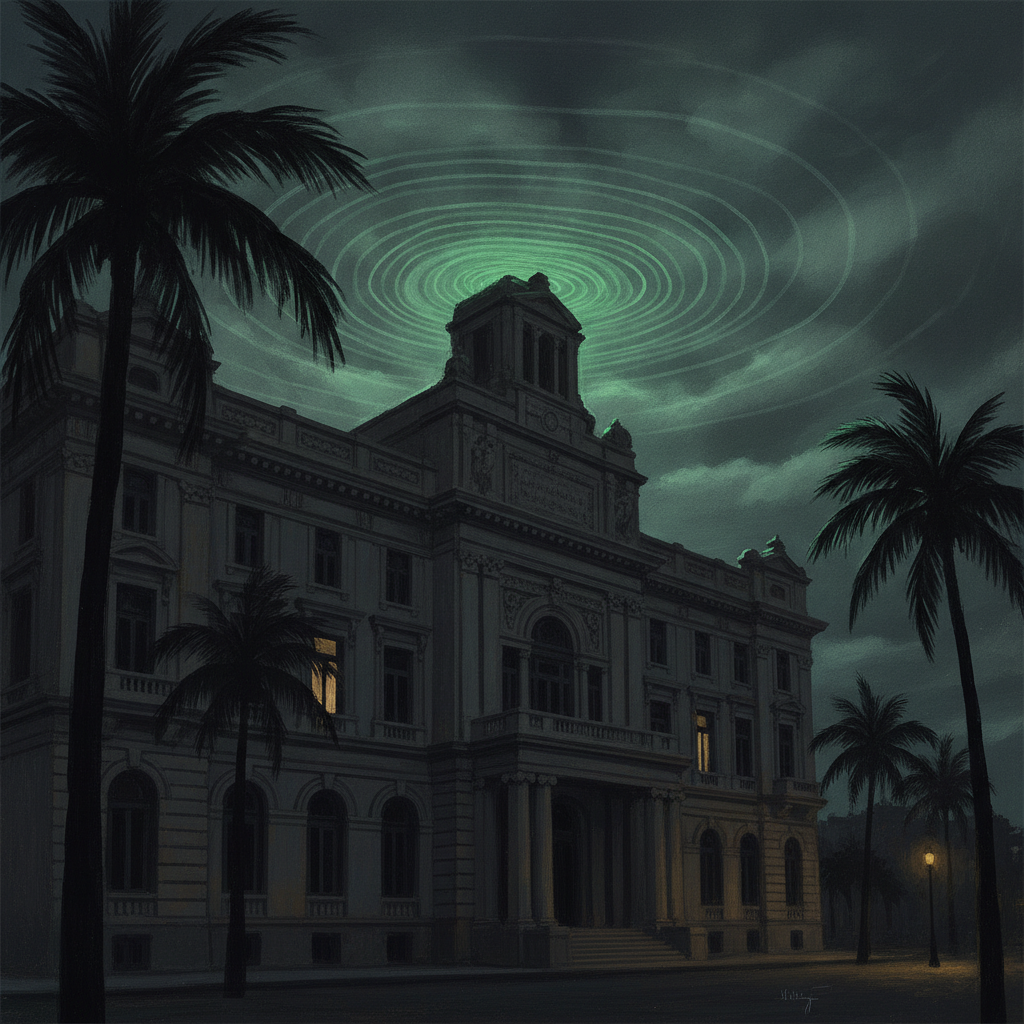
Havana Syndrome: The Invisible Illness That Split American Intelligence
It came, one officer said, like a beam of sound aimed directly at his head.
In December 2016 a CIA officer working under diplomatic cover in Havana was in his apartment when a piercing, high-pitched noise seemed to bore in from a single direction. Within days came dizziness, pressure headaches and hearing loss. He was the first documented case of what the world would come to call Havana Syndrome, though the United States government, weighing every word, insisted on the flatter and more careful label anomalous health incidents.
The reports did not stay in Cuba. In 2018 American personnel in Guangzhou, China, described similar experiences; among them was a Commerce Department official named Robyn Garfield, who reported strange night-time sounds followed by memory and balance problems that spread through his whole family. Cases followed in Vienna, in Washington itself, and at diplomatic postings across the world. Some officers were medically evacuated, and some say to this day that they never fully recovered. By early 2023 roughly 1,500 reports had been filed by US employees and their relatives, a number that turned a diplomatic curiosity into what officials treated as a national-security emergency.
What the affected described had a rough family resemblance. The onset was typically sudden and, in the earliest accounts, seemed to arrive from one direction. It was often followed by dizziness, pressure or pain in the head, ringing in the ears or loss of hearing, and later by difficulty with balance, memory and concentration, along with fatigue that did not lift. The pattern travelled with American power, wherever the country's diplomats and intelligence officers went.
Behind the statistics were individual cases. Marc Polymeropoulos, a senior CIA officer, was struck in a Moscow hotel room in December 2017 by vertigo so violent that he could not stand; he retired two years later, still tormented by headaches, and became one of the most public faces of the affair. Canadian diplomats posted to Havana were affected as well, and later went to court against their own government over how it had handled their care.
The sound itself was never one sound. Some heard a piercing whine, others a grinding or a mechanical buzzing, and some felt only pressure or heat with no noise at all.
The first major official verdict landed in December 2020. A committee of the National Academies of Sciences, Engineering, and Medicine, convened at the request of the State Department, concluded that directed, pulsed radiofrequency energy, a category that includes microwaves, was the most plausible mechanism for the core, earliest cases. The committee pointedly declined to name a culprit or a country. In 2021, with rare bipartisan speed, Congress passed the HAVANA Act to compensate those who had been hurt. By then the affair had drawn in the State Department, the CIA, the FBI, the Pentagon and eventually the National Institutes of Health, and outside scientific panels had been convened more than once.
Other findings had been accumulating from the start. As early as 2018 the FBI's Behavioral Analysis Unit visited Havana and judged the episodes a case of mass psychogenic illness, a real and involuntary spread of symptoms through a frightened, tight-knit community. In January 2019 the biologists Alexander Stubbs of Berkeley and Fernando Montealegre-Z of Lincoln analysed an Associated Press recording of the Havana sound and reported that it matched, pulse for pulse, the calling song of the Indies short-tailed cricket, Anurogryllus celerinictus.
The medical picture moved more than once. In 2018 a University of Pennsylvania team led by Douglas Smith reported in JAMA that a group of the Havana patients showed changes in the brain's connective networks, a finding presented as evidence of real injury and then heavily criticised on methodological grounds. In January 2022 a CIA interim assessment concluded that most of the reported cases could plausibly be explained by illness, environmental factors or stress, while conceding that around two dozen could not.
The strongest official blow to the weapon theory came in March 2023. The US intelligence community, pooling the judgement of seven agencies, reported that five of them considered it very unlikely that a foreign adversary was responsible, and that none had found credible evidence that any adversary even possessed such a weapon. The incidents, the assessment suggested, were more plausibly explained by pre-existing conditions, ordinary illnesses, environmental factors, stress and social dynamics.
Medicine appeared to close the door further. In March 2024 the National Institutes of Health published two studies in JAMA, the fruit of nearly five years of work. In one, sophisticated MRI scans compared the brains of 81 affected personnel with those of 48 people in similar jobs who had not reported incidents; a companion study examined a larger group. The researchers found no MRI-detectable brain injury and no significant difference from the comparison group across most measures. They were careful in how they said it: the suffering was real, sometimes profound and disabling, with measurable problems of balance, fatigue, post-traumatic stress and depression. But its signature, on every instrument they could bring to bear, was not that of a wound inflicted by a weapon.
That same spring the case reopened from another direction. A joint investigation by CBS's 60 Minutes, the outlet The Insider and the German magazine Der Spiegel reported evidence, disputed and firmly rejected by the intelligence community, that members of a Russian military-intelligence unit known as GRU 29155 had been placed near the sites of incidents, in at least several cases at the relevant times, and that one operative had allegedly been rewarded for work on non-lethal acoustic weapons. The journalists, among them the investigator Christo Grozev, later testified before Congress. CIA Director William Burns publicly restated his agency's scepticism. The House Intelligence Committee, however, took the reporting seriously enough to question the 2023 assessment itself, suggesting that it had been assembled in irregular ways.
Nearly a decade after the first report, that is where the documented record stands: roughly 1,500 filings, a sequence of official findings that contradict one another, no recovered device, and a group of patients whose symptoms are measurable and whose cause is not.
Conclusions and Open Questions
Nine years of investigation produced four serious explanations, each carrying its own wound.
The directed-energy hypothesis is the reading the National Academies committee endorsed in 2020, and it remains the position of many affected officers. Its strength is that it fits the sudden, one-directional onset the first patients described. Its weakness is that no such non-lethal weapon has ever been shown to exist, that no device or blueprint has been recovered in nearly a decade, and that many physicists doubt one could be built and aimed as neatly as the accounts require.
The psychogenic explanation, advanced by the FBI's Behavioral Analysis Unit in 2018 and echoed in the 2023 intelligence assessment, accounts for how symptoms can spread through close, high-stress communities once fear takes hold. Its weakness is that it strains against the very first cases, reported before there was any syndrome to catch, and that patients experience it as a polite way of dismissing real injury.
The cricket finding of Stubbs and Montealegre-Z is a small masterpiece of debunking, and it dissolves the most sinister single artefact in the file, the recording itself. Its weakness is scope. It explains one recording, and a cricket cannot cause a concussion or a year of vertigo.
The reporting on the Russian unit by 60 Minutes, The Insider and Der Spiegel supplies motive, opportunity and a plausible culprit. Its weakness is that it supplies no mechanism, no recovered weapon and no proof that would stand in a court or a laboratory, and that the intelligence community rejects it outright.
What remains unexplained is the ambiguity itself. Almost every piece of evidence is compatible with more than one story. A directional sound can be a weapon or a cricket heard through an open window. A scan that finds nothing can mean there was no injury, or an injury too subtle to image. Each institution tended to see what its own methods were built to see, so the same facts produced a weapon in one building and a delusion in another.
The open questions are pointed. If crickets and stress explain Havana, why did trained officers in hostile postings mistake an insect or their own nerves for a weapon aimed at their skulls? Why would the sober scientists of the National Academies reach for directed energy if the evidence was as thin as the agencies later implied? If a weapon exists, why has no device, no blueprint and no defector's account of one ever surfaced? Why did five agencies, with every incentive to expose a foreign hand, conclude there was none to expose? And the House committee's objection that the 2023 assessment was assembled irregularly has never been resolved in public.
Some argue that the hunt for a single unifying answer is itself the mistake. One theory holds that Havana Syndrome was never one phenomenon: that a small number of genuinely unexplained early cases gave rise to a label broad and frightening enough to gather in, over the following years, hundreds of ordinary ailments, ambiguous noises and anxious misreadings of the body. On that view there is a real mystery at the core and a wide human penumbra of coincidence around it, impossible to separate after the fact. It is offered here as speculation and nothing more.
What is certain is smaller and stranger than any of the theories. Something happened in Havana in the winter of 2016. Real people were hurt, and remain hurt. And the most powerful intelligence services and the most advanced medical institutions on earth turned their finest instruments on their own people, spent years and fortunes, and could not agree with one another, or with themselves from one year to the next.