The Hessdalen Lights: The Valley Where Science Chases Glowing Orbs
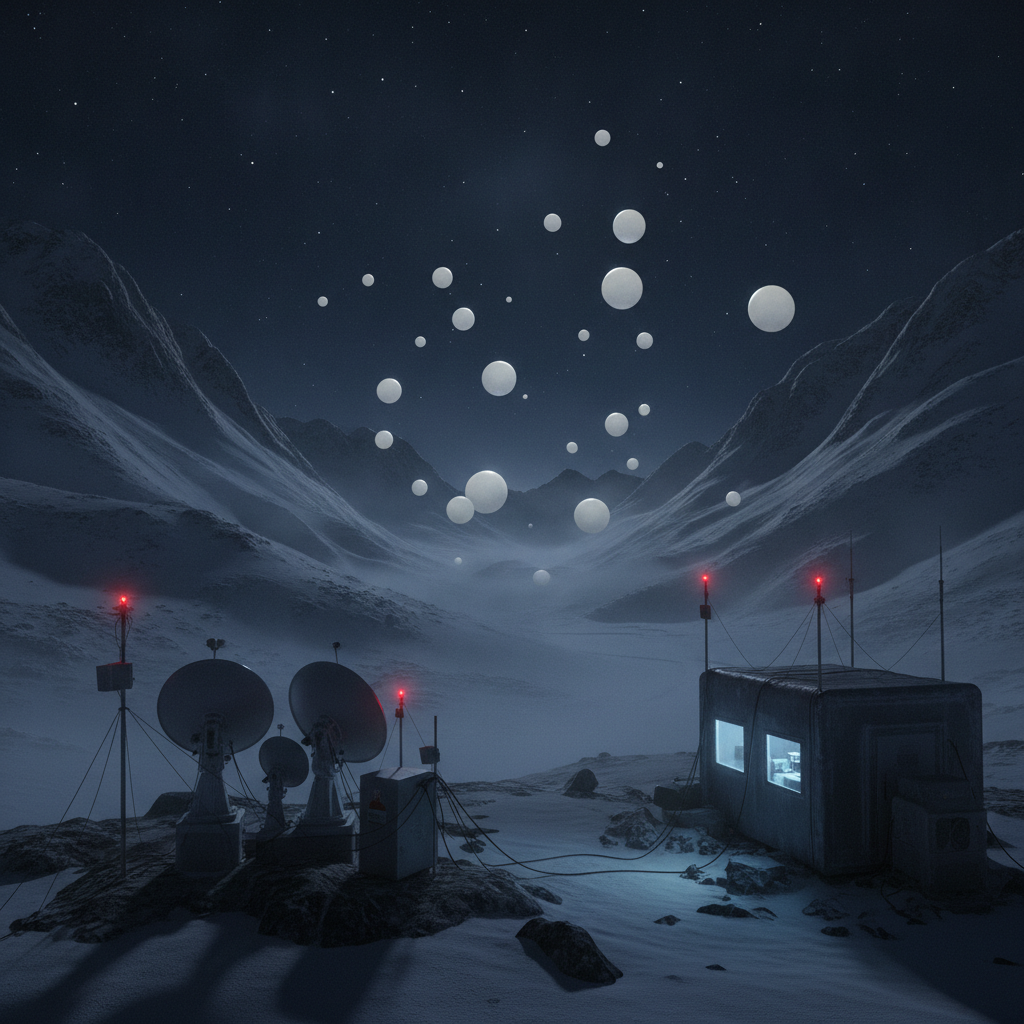
Hessdalen is a narrow valley in central Norway, about fifteen kilometres long, roughly 120 kilometres south of Trondheim, and home to only a few hundred people. For more than four decades it has been the setting of one of the most heavily instrumented unexplained phenomena anywhere in the world. Silent balls of light appear over its hills without warning. They hover, brighten, drift low along the ridgelines, sometimes divide into several smaller lights that travel together, and then fade out. They leave no sound behind them and no mark on the snow below.
The lights did not arrive with the modern interest in flying saucers. Older residents of the valley described strange glows drifting over the hills as far back as the 1930s, long before the vocabulary of unidentified flying objects existed in Norway. People who live in Hessdalen have generally treated the phenomenon less as a visitation than as a feature of the place, something the valley simply does, unsettling but familiar.
The phenomenon entered public view in December 1981, when an intense wave of sightings began. At its height, through 1982 and 1983, residents reported the lights as often as twenty times a week, and on some nights several times between dusk and dawn. The witnesses included farmers, bus drivers and police officers. A number of the events were captured on film.
The reports covered a wide range of appearances. Some lights were small, quick flashes. Others were luminous shapes estimated at several metres across, glowing white or yellow and occasionally red or blue. Witnesses described objects that hung motionless for minutes at a time and then crossed the sky faster than any aircraft, and others that floated so slowly and so low that they could be watched from a kitchen window until they simply faded. Drivers reported a luminous object roughly the size of a car floating a few metres above the road and keeping pace with them for a stretch before disappearing. Others watched a bright shape hover above a rooftop, cast a visible glow onto the snow and then drift away behind a hill. Some of the lights were reported blinking in a slow, regular rhythm. Almost all of them were silent.
What distinguishes Hessdalen from other accounts of unexplained lights is what happened next. In the summer of 1983 a field project moved into the valley and began to measure. It was launched by the UFO organisations of Norway and Sweden, supported in part by the University of Bergen, and equipped partly with instruments borrowed from the military. It became known as Project Hessdalen and was led by the engineer Erling Strand of Ostfold University College. The team hauled cameras, radar, spectrum analysers, magnetometers and laser equipment into the snow.
Results came quickly. In a single winter campaign, running from 21 January to 26 February 1984, the team logged fifty-three separate light observations. Since 1998 an automated monitoring station in the valley, nicknamed the Blue Box, has watched the sky around the clock, photographing and recording anything that moves or glows. From 1999 an Italian team joined the work: the astrophysicist Massimo Teodorani and Stelio Montebugnoli of the Medicina radio astronomy station near Bologna, in a series of measurement campaigns called EMBLA.
The instruments produced hard numbers. Optical spectra pointed to glowing ionized gas, with nitrogen and oxygen dominant and traces of heavier elements including scandium and iron. The spectra also showed lines consistent with helium, which some researchers connected to the decay of radon in the valley air. The radiant power of one light was measured at roughly 19 kilowatts, more than ten times the output of a helicopter searchlight, and photometric analysis of the brightest events has produced figures far higher, approaching a hundred kilowatts.
The behaviour was as distinctive as the energy. Brightness pulsed on timescales of a second or less, usually fading after a handful of cycles. Night vision optics revealed a strong infrared signature even when a light was faint or invisible to the naked eye. The phenomenon frequently failed to behave like a single object at all: it would break into clusters of smaller balls that held their spacing and moved together, behaviour Teodorani described as thermodynamically self regulated. Individual events sometimes lasted a quarter of an hour.
Different instruments often disagreed with one another. On some nights a camera registered a soft glow low on a hillside while, on the same bearing, radar traced a contact moving far faster than the dim light in the lens. On other nights the magnetometers recorded disturbances with no visible light at all. In a number of reported cases photographs, radar echoes and magnetic readings coincided in the same minute.
Over the years the valley became a working field laboratory. Students from Ostfold University College have run yearly field courses there. Workshops held in the valley have drawn physicists, geologists and astronomers, researchers with no interest in flying saucer stories but a professional interest in a repeatable, measurable anomaly that returns to a fixed location. The state of that work is unusual in the study of anomalies: instead of a single grainy photograph or one unverifiable witness, Hessdalen has produced spectra, radar logs, magnetometer traces and thousands of images gathered from the same few square kilometres over decades.
Four decades of measurement settled one point beyond serious dispute. The lights are a real physical phenomenon rather than folklore or shared illusion. They have been photographed repeatedly and, in a number of cases, registered by radar and by magnetometers at the same moment. They are not confined to one witness, one season or one vantage point, and they have outlasted every generation of equipment brought to record them.
The great wave has calmed since the 1980s, but the phenomenon has not stopped. Sightings are still logged in most years. The Blue Box still watches through the long northern nights, and researchers from as far away as Germany have brought their own instruments to add to Strand's. Hessdalen remains one of the very few unexplained phenomena that has been under continuous scientific observation for more than forty years.
Conclusions and Open Questions
The straightforward explanations have all been tested, and none covers the record. Early skeptics proposed that the lights were car headlights on distant roads. The researchers who mapped the sightings answered that the geometry does not fit: lights appear where no road runs, at angles no headlight could reach, and move in ways headlights cannot. Ball lightning is a natural candidate, but it is measured in seconds, not the fifteen minutes Hessdalen sometimes sustains. Swamp gas and an unusually southern aurora have also been suggested, and neither matches the recorded spectra or the terrain.
Three serious physical models remain, each explaining one part of the pattern.
Teodorani proposed an ionized dust plasma, possibly seeded by the decay of radon in the valley air. The model fits the measured spectra, the helium lines and the rapid pulsing, and it would account for the clusters that hold their spacing. Its weakness is mechanical: no one has shown how such a cloud could stay suspended for minutes without dispersing.
A second explanation, favoured by geologists who point to the quartz rich rock of the valley, is piezoelectric. Tectonic stress on quartz generates electric fields, and strong enough fields would ionize the surrounding air. The idea has laboratory support, but no field measurement has ever tied a specific strain event in the rock to a specific light in the sky.
The third model comes from a team of Italian geologists, who described the valley itself as a natural battery: one slope rich in zinc and iron, the other in copper, with sulphurous water seeping between them and driving electric currents through the ground. The mineralogy is real and the chemistry is sound, but a battery explains a current in rock, not a luminous ball drifting freely through the open air above it.
What remains unexplained is the combination rather than any single element. Some process in this valley can pour kilowatts of visible light into a slow moving volume of air, sustain it for minutes, pulse it, and split it into a group of smaller lights that keep formation. No accepted physics accounts comfortably for that mixture of power, duration and apparent control. That gap is the actual mystery of Hessdalen.
One theory holds that Hessdalen is not one phenomenon but several, honestly confused with one another: a genuine plasma or electrochemical effect behind the best measured cases, and a residue of misidentified aircraft, bright planets and distant headlights filling out the rest of the logbook. That would explain why every model captures part of the pattern and none captures all of it. It has never been demonstrated, however, and risks becoming an excuse to discard inconvenient observations.
Some argue that the disagreement between instruments points to something more exotic, an unrecognised state of matter or an energy source not yet described. Nothing in the measured record requires that conclusion; the readings are unusual rather than miraculous, and the honest description of the file is an unsolved problem in atmospheric physics.
The open questions are precise. What supplies the energy, at kilowatt levels, night after night, in one small valley? What holds a luminous plasma stable for minutes when laboratory plasmas dissipate in a fraction of a second? Why do radar, optical and magnetic sensors so often record different things at the same moment and bearing? Why did the rate of sightings fall so sharply after 1983? And why here, in these fifteen kilometres of Norwegian upland, and almost nowhere else? After more than forty years of measurement, the answer to every one of them is the same: nobody yet knows.