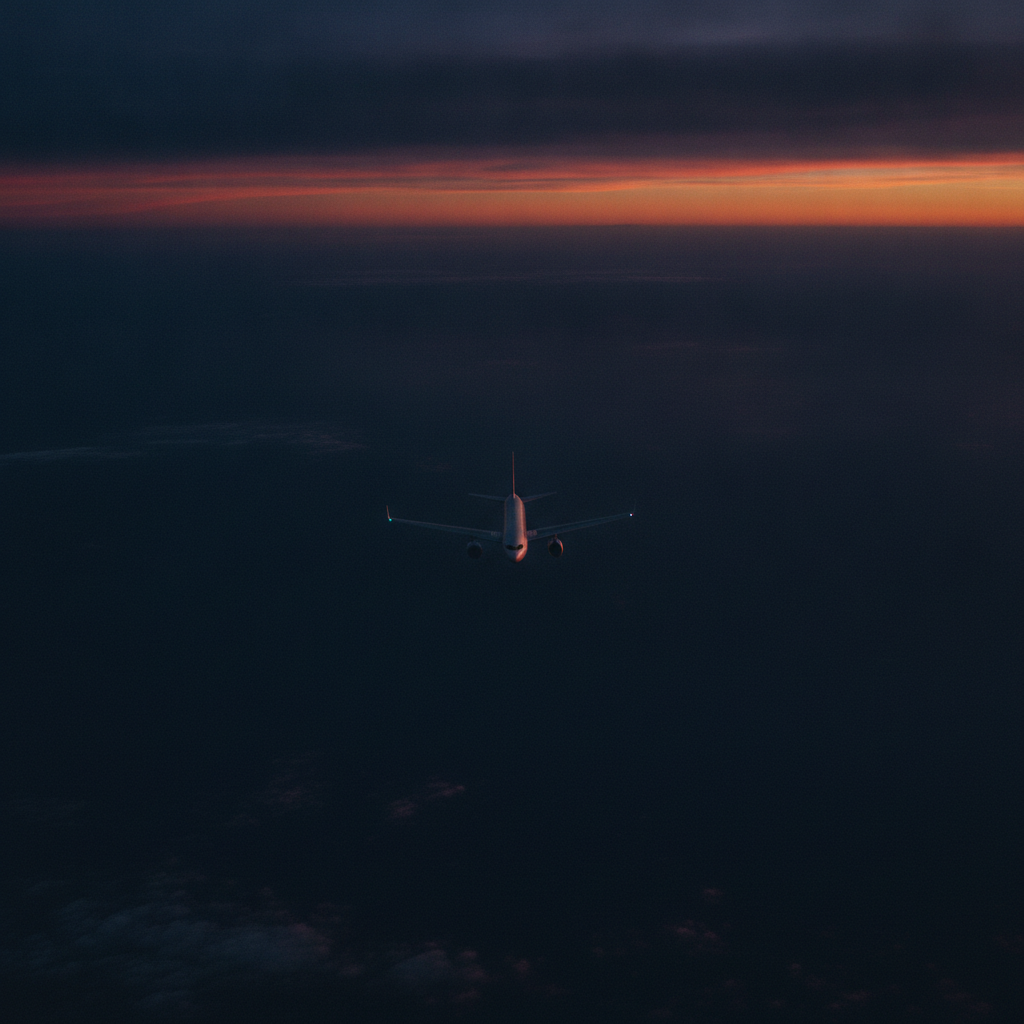
MH370: The Airliner That Vanished — and the Search That Refuses to End
At nineteen minutes past one in the morning on March 8, 2014, a voice from the cockpit of Malaysia Airlines Flight 370 spoke six ordinary words to air traffic control in Kuala Lumpur: "Good night, Malaysian three seven zero." Nothing in the tone suggested anything was wrong. The Boeing 777-200ER, registration 9M-MRO, was climbing through the dark toward Beijing with 227 passengers and 12 crew aboard, and it was passing from Malaysian into Vietnamese airspace over the South China Sea. Those were the last words the world would ever hear from the flight.
Within about two minutes the aircraft's transponder stopped responding. The green symbol that identifies an airliner to civilian controllers dropped off the screens, and Flight 370 was gone from air traffic control. Vietnamese controllers, expecting to take over the flight, never made contact. Hours passed before the scale of the problem was understood, and the first search effort was directed at the South China Sea along the planned route to Beijing, where the plane had last been seen. Nothing was ever found there.
The reason nothing was found there emerged from military records. Malaysian military radar, reviewed in the days that followed, showed the jet had not continued toward Beijing at all. It banked into a wide turn and flew back the way it had come, recrossing the Malay Peninsula, then turned again to track northwest up the Strait of Malacca. It was last held on military radar at around 2:22 a.m., near the small island of Pulau Perak, before it passed beyond the reach of any radar coverage and out over the open Indian Ocean.
That should have been the end of the trail. It was not, because of a piece of equipment nobody expected to matter. High above the ocean sat Inmarsat's 3F1 communications satellite, and roughly once an hour it exchanged an automated electronic handshake with a terminal aboard the aircraft, a silent digital greeting carrying no message, no position and nothing a person had typed. After the disaster, engineers realised these handshakes contained faint mathematical fingerprints. The timing of each signal encoded a distance from the satellite, and the frequency encoded something about the aircraft's motion relative to it.
Applying a method never before used to locate a missing airliner, and later validated against data from other flights, the Inmarsat team showed that MH370 had kept flying for nearly six more hours after it left radar. The final complete handshake, at 8:19 a.m., placed the aircraft somewhere along a vast curve through the remote southern Indian Ocean that became known as the seventh arc. The analysis indicated the aircraft was by then out of fuel. Somewhere on that arc, far from land, it came down.
What followed was the largest and most expensive search in the history of aviation. An underwater operation led by Australia, working from the satellite analysis and drift studies, scoured roughly 120,000 square kilometres of some of the most hostile and least mapped seabed on the planet, a landscape of undersea mountains and trenches thousands of metres deep. It ran for close to three years and was suspended in January 2017 with nothing found. In 2018 an American robotics company, Ocean Infinity, swept a further 112,000 square kilometres under an arrangement it called no find, no fee, deploying autonomous underwater vehicles that combed the darkness. It too came up empty.
In late 2025 the same company returned under a fresh agreement with Malaysia, reported to be worth around 70 million dollars and again payable only on success. It searched a new high-priority zone until the operation was paused around January 23, 2026, driven off by the southern winter and once more without result. Malaysia has kept the contract open, and the vessels are expected to return to finish the ground that remains.
The ocean itself has not been entirely silent. On July 29, 2015, nearly seventeen months after the disappearance, a wing component called a flaperon, crusted with goose barnacles, washed up on a beach on Reunion Island in the western Indian Ocean. It was formally confirmed as part of MH370, the first physical proof that the aircraft had ended in the sea. In the years that followed, more than thirty pieces of suspected debris were recovered along the coastlines of Mozambique, South Africa, Madagascar, Mauritius and Tanzania. Several were positively identified as coming from the aircraft. Many were gathered by a determined American named Blaine Gibson, who took it upon himself to search the beaches.
Oceanographers who modelled how wreckage would drift on Indian Ocean currents found the pattern broadly consistent with an origin along the seventh arc, though the modelling could not narrow the crash site to a point. Examination of some recovered items was consistent with the aircraft breaking up on impact with the water. Beyond that, the debris said little: each fragment was in effect a message without a return address.
The official Malaysian safety investigation, published in 2018, set out the timeline in detail and then stopped short of the one thing everyone wanted. It could not determine the cause of the disappearance. It stated that the turn back was likely made under manual control rather than by autopilot, and it did not accuse the crew or anyone else. No cause has been formally established since.
Twelve years on, the flight recorders have never been recovered. The cockpit voice recorder and the flight data recorder, the only devices that could describe what happened inside the aircraft after that final radio call, lie somewhere on the southern Indian Ocean seabed. Of the 239 people aboard, no remains have ever been recovered or identified. Their families have spent more than a decade petitioning governments and pressing for the search to continue. Search boats are still expected to return.
Conclusions and Open Questions
The most discussed explanation, and the most painful, is the theory that one of the pilots deliberately took the aircraft to the sea. Captain Zaharie Ahmad Shah, 53, was an experienced aviator, and investigators recovered from his home flight simulator a set of saved data points showing a route down the Malacca Strait and out into the southern Indian Ocean, ending with fuel exhausted over open water, plotted only weeks before the flight. Its strength is that it fits the physical evidence better than any rival: the manual turns, the silenced transponder, the long steady track toward one of the remotest places on earth. Its weakness is decisive. It rests entirely on circumstance and inference, not proof. No motive was ever established, those who knew Zaharie described a stable and devoted man, the simulator points can be read as the idle curiosity of an enthusiast who logged hundreds of such flights, and the official investigation pointedly declined to accuse him. This theory remains unproven, and nothing in the public record justifies treating a named man as a mass murderer.
A related theory holds that the aircraft was hijacked or commandeered by a third party who forced or fooled their way to the controls. It accounts for a deliberate diversion without implicating the crew. But it founders on the absence of everything a hijacking normally leaves behind. There was no claim of responsibility, no ransom demand, no political message, no group that surfaced to take credit and no wreck from which a plot might be reconstructed.
A third explanation is accidental catastrophe, most often a sudden loss of cabin pressure that incapacitated everyone aboard, leaving the aircraft to fly on under autopilot as a so-called ghost flight until its tanks ran dry. It requires no villain and fits the long, silent, straight final leg south. Its problem is the beginning rather than the end. A depressurisation that disables the crew does not easily explain the series of turns back across the peninsula and up the strait, manoeuvres that appear to require a conscious pilot at exactly the time everyone would have been unconscious. A variant argued early by the pilot Chris Goodfellow proposed an onboard fire or electrical emergency that knocked out communications and sent the crew turning toward the nearest runway at Langkawi. It explains the first turn and the dead radios, but not the hours of controlled flight that followed in the opposite direction from any airport.
Independent investigators have pushed further. The aerospace engineer Richard Godfrey has tried to fix the crash site using a technique built on the faint disturbances that aircraft cause to amateur radio signals crossing the globe, known as WSPR, and has offered specific coordinates along with a picture of a pilot possibly disoriented by hypoxia in the final phase. The appeal is that it dares to be precise where officialdom offers only an arc. The trouble is that his calculated position has shifted more than once, and many scientists regard the underlying method as unproven for tracking a specific aircraft across an ocean.
What remains unexplained is the whole middle of the story. The satellite handshakes establish that the aircraft flew for hours and roughly where it ended, but nothing establishes who or what was controlling it, or why. The sophistication of the diversion is itself an open question: switching off a transponder at the seam between two nations' airspace, at the one moment a disappearance might go unnoticed longest, and then threading a path along the edge of radar coverage, is not obviously the behaviour of a failing machine. Yet if the diversion was intentional, the intent points nowhere, to no demand and no message, which argues against the simplest human explanations. Some argue the search zone itself has been wrong from the start, since four campaigns across more than 200,000 square kilometres have found nothing; others counter that the seabed searched is a fraction of the arc's plausible length. Until the flight recorders are found and read, the honest position is that the case is open. We know the aircraft turned. We know it flew for close to seven hours. We know it came down in the sea. We do not know where, we do not know why, and we do not know what happened in that cockpit between a calm good night and the last handshake at 8:19 in the morning.