D.B. Cooper: The Hijacker Who Jumped into the Night and Never Landed
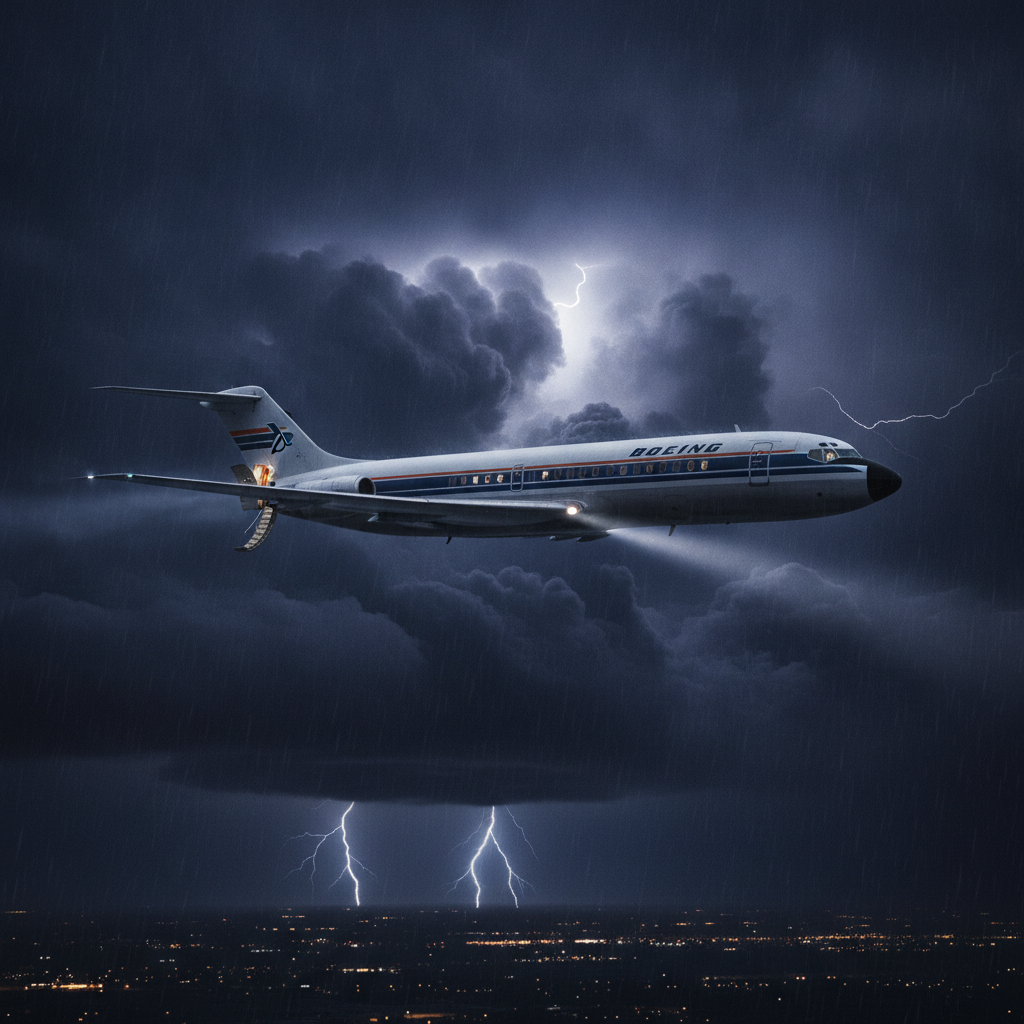
On the afternoon of November 24, 1971, the day before Thanksgiving, a man in a dark business suit paid cash for a one way ticket at the Northwest Orient counter in Portland, Oregon. He signed the ticket Dan Cooper and took a seat near the back of Flight 305, a Boeing 727 on a short hop north to Seattle. Passengers and crew described him as a quiet, olive skinned man in his mid forties, in a black clip on tie, raincoat and loafers, carrying a briefcase. He ordered a bourbon and soda, lit a cigarette, and handed a note to flight attendant Florence Schaffner. She assumed it was a lonely businessman passing along his phone number and dropped it into her purse unread. He leaned toward her. "Miss, you'd better look at that note," he said. "I have a bomb." When she sat down beside him he opened the briefcase just far enough to show a tangle of wires, red cylinders and a battery.
His demands were exact: $200,000 in twenty dollar bills, ten thousand notes worth well over a million dollars in today's money, plus four parachutes, waiting when the aircraft landed in Seattle. Captain William Scott relayed the message to the ground, and Northwest Orient's president authorized payment. The plane held over Puget Sound for about two hours while the airline gathered the cash from a Seattle bank and the FBI photographed every single bill to record its serial number, while the passengers were told only that a minor mechanical problem had caused the delay.
At Seattle-Tacoma Airport the aircraft was refueled and the money and parachutes were carried aboard. Cooper released all thirty six passengers and two of the flight attendants. He kept the two pilots, the flight engineer and flight attendant Tina Mucklow. Then he dictated a flight plan that aviation people still study: heading for Mexico City, altitude ten thousand feet, landing gear down, wing flaps at fifteen degrees, cabin unpressurized, airspeed low, and the rear airstair unlocked. It is precisely the configuration that keeps a Boeing 727 slow and low enough for a person to step off the tail stairs and survive. Because that cut the range so sharply, a refueling stop in Reno, Nevada, was agreed.
Cooper also asked for his note back, and Schaffner returned it, which is why not a single line of the hijacker's handwriting survives from that night. What does survive is the FBI's composite sketch, drawn from the crew's descriptions: a lean man with a square jaw, dark hair combed back, narrow tie. Witnesses agreed on the essentials, differed on the details, and the sketch could pass for many ordinary middle aged American men.
For most of those hours Tina Mucklow was the only person sitting with him, relaying his instructions by interphone and staying in the cabin as it emptied. Her account describes a composed, articulate man who was never cruel, ordered a second bourbon, tried to press the change on her, and appeared entirely at ease. He also appeared to know the area. He remarked that McChord Air Force Base was about twenty minutes by air from Seattle-Tacoma, and, looking down into the dark, he seemed to recognize the lights of Tacoma below.
Flight 305 took off again into heavy weather and turned south. At about 8:13 p.m., somewhere over the forests of southwest Washington, the crew felt the tail dip and a faint pressure change move through the cabin. Cooper had walked down the aft stairs and stepped out into a freezing November night: driving rain, a slipstream of roughly two hundred miles an hour, a wind chill far below zero, with the bag of money lashed to his body. When the aircraft landed in Reno the cabin was empty. He left behind his black tie with its mother of pearl clip, two of the four parachutes and eight filter tipped cigarette butts. One of the two reserve parachutes he had been given was a sewn shut classroom training rig, unusable, and he had either failed to notice or not cared.
Two F-106 fighter jets had been scrambled to shadow Flight 305, and an Air National Guard trainer trailed it too. None of the pilots saw a man leave the aircraft in the black, rain filled sky. The manhunt that followed, code named NORJAK, ran for forty five years, interviewed hundreds of people and examined roughly a thousand suspects without ever charging one. The FBI's original calculations placed the drop zone near Lake Merwin, north of Portland, and agents combed those woods for years in one of the largest ground searches in bureau history. It produced nothing except a placard from the aft stairway, found by a hunter near the flight path in 1978.
Even the name is an accident: a wire service reporter confused the details and turned "Dan Cooper" into "D.B. Cooper," and the error stuck to the case permanently.
The first physical break came in February 1980. An eight year old boy named Brian Ingram, digging a fire pit on a Columbia River sandbar called Tena Bar, uncovered three rotting bundles of twenty dollar bills: $5,800 whose serial numbers matched the ransom. The find raised as many problems as it solved. Tena Bar lies miles from any plausible drift path out of the estimated drop zone. A 2020 analysis of diatoms, the microscopic algae clinging to the notes, led by researcher Tom Kaye, concluded that the money entered the water in spring, months after the November jump. It is also documented that a dredging operation deposited river sand on that bar in 1974.
The tie became the case's other physical exhibit. Kaye's team lifted more than 100,000 particles from it, including cerium, strontium sulfide and pure titanium, and later flecks of a rare titanium antimony alloy that researcher Eric Ulis traced to a Pennsylvania metals plant supplying the aerospace industry. Ulis sued the FBI in 2023 to have the tie retested; a judge dismissed the suit. A degraded partial DNA profile was also recovered from the tie, and in 2024 the children of one long standing suspect handed agents a modified parachute and skydiving logbook from the family's North Carolina property, prompting fresh comparisons.
The hijacking permanently changed commercial aviation. Within months the Federal Aviation Administration ordered every Boeing 727 fitted with a spring loaded aerodynamic wedge, named by engineers the Cooper Vane, that uses the airflow of flight to lock the rear airstair shut. A wave of copycat parachute hijackings in 1972, most quickly ended, helped push American airports toward universal passenger screening and metal detectors. Cooper himself became a folk figure, with songs, T shirts and an annual gathering of amateur investigators. The FBI formally suspended the file in July 2016, leaving it the only unsolved commercial airliner hijacking in American history.
Conclusions and Open Questions
The evidence points two ways at once. The hijacking looks like the work of someone with aviation knowledge: the flaps at fifteen degrees, the choice of the one airliner with a jumpable rear stair, even the demand for four parachutes, which quietly implied a hostage might be forced to jump too and so discouraged the FBI from supplying sabotaged gear. The jump itself looks like the work of an amateur: at night, into a storm, in loafers and a raincoat, without a helmet, using the older non steerable military canopy, and missing the sewn shut reserve entirely. Skydivers consulted by the FBI doubted an experienced jumper would have done any of it.
The suspects each account for part of the picture. Richard McCoy Jr. staged a near identical hijacking five months later, jumped with $500,000 and was caught; the FBI long set him aside as too young and not matching the descriptions, and the 2024 family material is being compared with the tie profile rather than proving anything yet. Kenneth Christiansen, a Northwest Orient purser and former paratrooper, hinted on his deathbed at a secret he could not tell; the bureau concluded he did not fit the witness description. Robert Rackstraw, a Vietnam veteran, pilot and explosives man, was pushed hard by a private cold case team, but he was only twenty eight in 1971 while witnesses put Cooper between thirty five and forty five, and he denied it until his death in 2019. Sheridan Peterson, a smokejumper who cheerfully agreed the FBI "had good reason to suspect me," fit the daredevil profile but was never tied to the flight. In 2011 Marla Cooper told the FBI her uncle L.D. Cooper came home bloodied and broke that Thanksgiving talking about a hijacking, a family memory with no corroboration.
Larry Carr, the agent who ran the case late in its life, argued the bleakest theory: that Cooper simply died on impact that night under the forest canopy, his money scattered by the storm. Its weakness is that no body, parachute or gear has ever been found, and the Tena Bar bundles fit it poorly. Carr also noted that "Dan Cooper" is the hero of a French language comic about a test pilot, a series never sold in the United States, which some read as a hint that the man had lived in Europe or French Canada.
The Tena Bar money remains the sharpest unexplained fact. Some argue the 1974 dredging spread the bundles there from the riverbed; others hold that a human hand buried them, either Cooper's or someone else's. Neither version explains the spring diatoms. The tie particles are equally ambiguous: one theory holds they place Cooper inside an aerospace plant, but a clip on tie from a department store could have been secondhand, borrowed or deliberately left, and the particles show where the fabric had been, not who wore it on Flight 305.
The open questions are simple and stubborn. Why has not one of ten thousand recorded bills ever surfaced in circulation in more than fifty years? How did buried ransom reach a sandbar outside the drift path, on the wrong calendar? Was the man an airline insider, a soldier, or a determined amateur who read enough to get one flight right? And if he lived, who did he spend the rest of his life as?