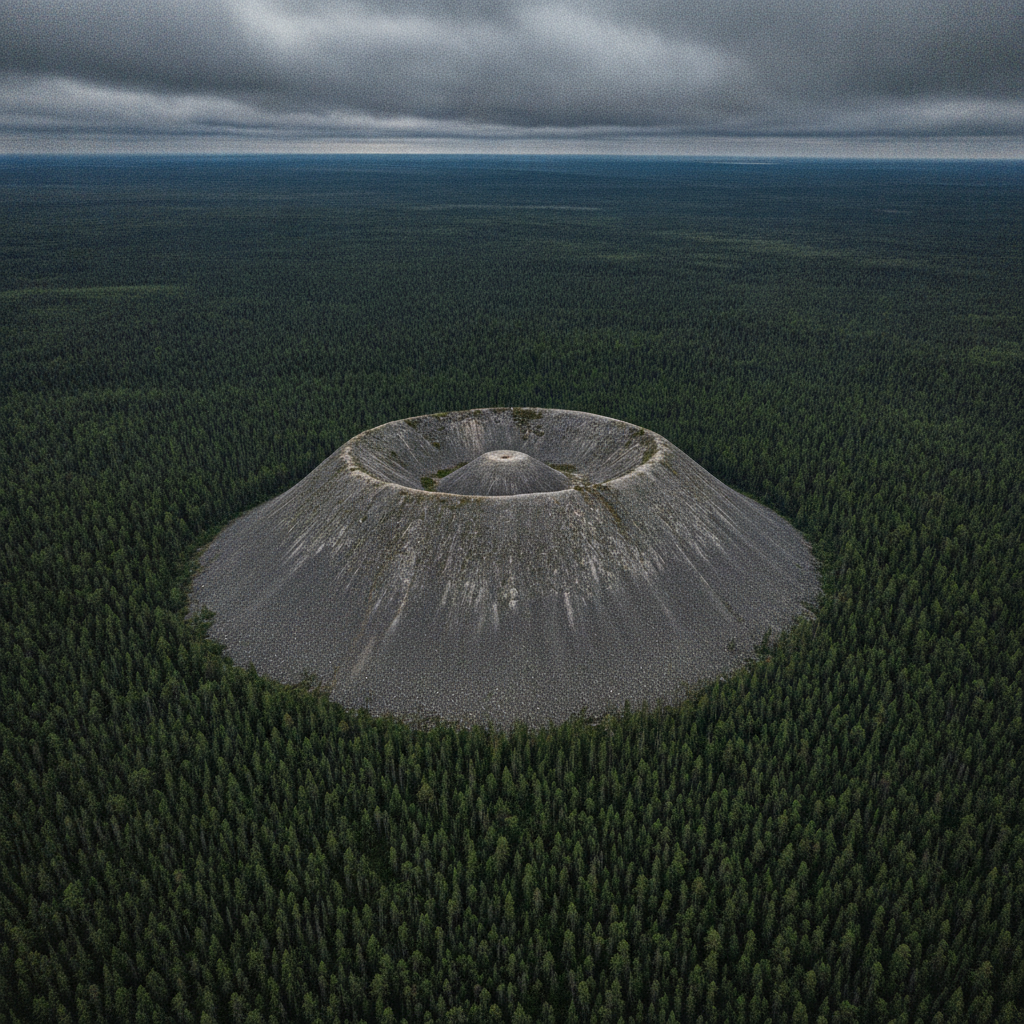
The Fire Eagle's Nest: What Built Siberia's Patomskiy Crater?
The Patom Highlands of eastern Siberia are among the least visited places in Russia. To reach the landform the local Yakut hunters called the Fire Eagle's Nest, a traveller must go far beyond the gold town of Bodaibo, into a roadless country of larch and permafrost where the nearest settlement is days away and the taiga closes over every trail. It was here, in the summer of 1949, that a young Soviet geologist named Vadim Kolpakov came through the trees and stopped. Rising out of the forested slope in front of him was a vast pale mound of broken gray stone, cone-shaped and flat-crowned, entirely unlike anything around it.
Kolpakov's first thought, he later wrote, was that he had stumbled on the waste heap of a mine. But there was no mine. No road ran to the place, no settlement lay within a great distance, and moving a million tons of shattered rock into a cone forty meters high would have occupied an army for years. His second thought was a volcano. This corner of Siberia has never had volcanoes, and the mound was built of the same limestone that lay beneath his boots, not of anything that had ever been molten. Whatever raised it had done so from below, forcing the region's own bedrock up through itself.
The structure, known ever since as the Patomskiy crater, is a cone of crushed limestone blocks roughly 40 meters high and about 160 meters across at the base. It holds an estimated quarter of a million cubic meters of rock and weighs on the order of a million tons. At its summit sits a ring-shaped crater, and inside that ring rises a rounded central dome some 12 meters tall. Seen from above the form is unmistakable: a nest, and within the nest an egg.
The plateau around it is geologically quiet, a stable block of ancient sedimentary rock with no volcanic province and no active rift. That is part of what makes the mound so difficult to place. Against the surrounding taiga the gray stone also looks strikingly fresh and unweathered, as though the ground had heaved recently. That impression has a measurement behind it. When researchers counted the growth rings of larches disturbed on and around the mound, the dendrochronology pointed to an age of roughly 250 to 350 years. In geological terms, where such features are usually measured in millions of years, the Fire Eagle's Nest is essentially new.
Long before Kolpakov, the mound was known to the Yakut and Evenk hunters of the region, who named it and avoided it, holding that men and reindeer who went too near did not always come back. That reputation is folklore rather than evidence, but it establishes that the structure was visible and known well before any scientist reached it.
For more than half a century after 1949 the crater was left largely alone. Bodaibo is hard enough to reach, the mound lies far beyond it, and getting there meant days through trackless forest. For decades the science of the place rested on Kolpakov's original description and little else. Only in the 2000s did properly equipped teams, some flown in by helicopter, begin to survey it in earnest, and even then their time on the stone was short. One of the strangest landforms in Russia has been studied, in total, for a matter of weeks.
Kolpakov himself favoured a meteorite, and the idea took root that the crater might mark where a fragment of the great 1908 Tunguska object had come to earth. Field expeditions tested it. No trace of meteoritic material has ever been recovered from the site: no nickel-iron, no shocked minerals, nothing of extraterrestrial origin. The shape pointed the other way as well. An impact punches a bowl down into the ground and throws debris outward, while the Patomskiy crater is a mass of rock pushed upward from beneath. At the scientific conference convened on the subject in 2010, the geologist Viktor Antipin reported that the meteoritic hypothesis had been set aside and retained, as he put it, only historical interest. The dating told against it too. If the larch rings are right, the mound was already a century or two old when the 1908 fireball crossed the sky far to the north.
A stranger result had meanwhile come from the trees themselves. Tree-ring studies indicated that around the 1840s, decades before any expedition arrived, larches near the mound abruptly began to grow far faster than normal, and the surge continued for years. Researchers compared the pattern to the accelerated, distorted growth reported in irradiated forests near Chernobyl, and analyses were reported to show elevated traces of uranium and strontium in the wood.
Instruments were then brought to the question. Expeditions between 2005 and 2010 carried Geiger counters up the slopes and found no radiation anomaly at the crater at all, nothing above the ordinary background of the taiga.
Those expeditions began under a shadow. In 2005 the first comprehensive scientific team set out for the mound, and its leader collapsed and died of a heart attack while still on the approach, never reaching the crater he had spent years trying to explain. The local people, who had long described the place as a bad spot best avoided, absorbed the death into their own account of it without surprise.
When the researchers who followed spread their instruments across the stone, the result they assembled was quieter than a buried reactor. Studies led by Antipin and colleagues of the Institute of Geochemistry in Irkutsk, reported around 2008, concluded that the mound bears the marks of an extrusive process driven by a rapid outbreak of deep fluids and gases, carbon dioxide and water, carbon monoxide and hydrogen, forcing their way up from far below and shattering and lifting the limestone as they came. Some researchers framed this as a form of cryovolcanism, an eruption not of fire but of cold, in which pressurized water and ground ice heaved crushed rock through the frozen earth, possibly during the Little Ice Age.
No one has yet drilled into the mound. Its interior has never been sampled, no vent or conduit has been located beneath it, and nothing comparable has been found anywhere else in the Patom Highlands. Everything known about the Fire Eagle's Nest has been read off its surface.
Conclusions and Open Questions
After seventy-five years the Fire Eagle's Nest still has no agreed cause. Several explanations have been seriously proposed, and each fails at a different point.
The meteorite hypothesis, first favoured by Kolpakov and later attached to the 1908 Tunguska event, had the virtue of familiarity, a known cause for a crater-like form. It fails completely on the absence of any impact material and on a structure that rises rather than sinks. The geologists' own verdict is that it now holds historical interest only.
The natural nuclear reactor idea, developed by researchers who linked the 1840s growth surge to the reported uranium and strontium traces, proposed that a concentration of uranium beneath the mound had reached the threshold of a slow, self-sustaining reaction. It had a genuine precedent behind it, since nature is known to have run such a reactor once, at Oklo in Gabon, two billion years ago. But the radiation surveys of 2005 to 2010 found nothing, and a natural reactor should have left a heat and isotope signature the mound does not carry.
The deep-degassing model, championed by Viktor Antipin and the Irkutsk group and now favoured by most geologists, fits the extrusive, pushed-up structure better than anything else and requires no exotic physics. Its weakness is that it leaves the ultimate energy source unnamed, and it cannot by itself explain why this one spot, and no other along the highlands, produced a stone nest.
The cryovolcanic variant is elegant and matches both the apparent youth and the cold setting, but cryovolcanism is a process confidently documented on the moons of the outer planets, not on forested Siberian slopes. Invoking it here is closer to a reasoned hope than a proof. A further suggestion, that the mound sits atop a kimberlite pipe of the kind that carries diamonds toward the surface elsewhere in Siberia, is intriguing and so far entirely unsupported by drilling or sampling.
Beyond the geology, some argue that the mound conceals something artificial, a buried object or a fallen craft, and point to the local taboo and the 2005 death as circumstantial support. One theory holds that it marks a concealed Soviet-era test or accident. These are open theories rather than findings. No measurement taken at the site supports either, and the 250 to 350 year dating rules out anything from the twentieth century.
What remains unexplained is considerable. A million tons of bedrock was lifted in the middle of a stable plateau with no volcano, no rift and no identified engine. No vent has been found. Nothing similar exists along the same highlands. The 1840s tree-ring surge has never been fully accounted for by any theory, including the leading one. And the form itself is oddly precise, a crater within a crater with a dome set neatly at its centre, which is not what a slow release of gas would be expected to build.
The open questions are simple to state and hard to answer. What lies under the mound, and will anyone drill to find out? Where did the energy come from? Why here and nowhere else? What happened to the larches in the 1840s, and was it connected to the mound at all? And is the 250 to 350 year age correct, or are the disturbed trees recording something later than the event itself?