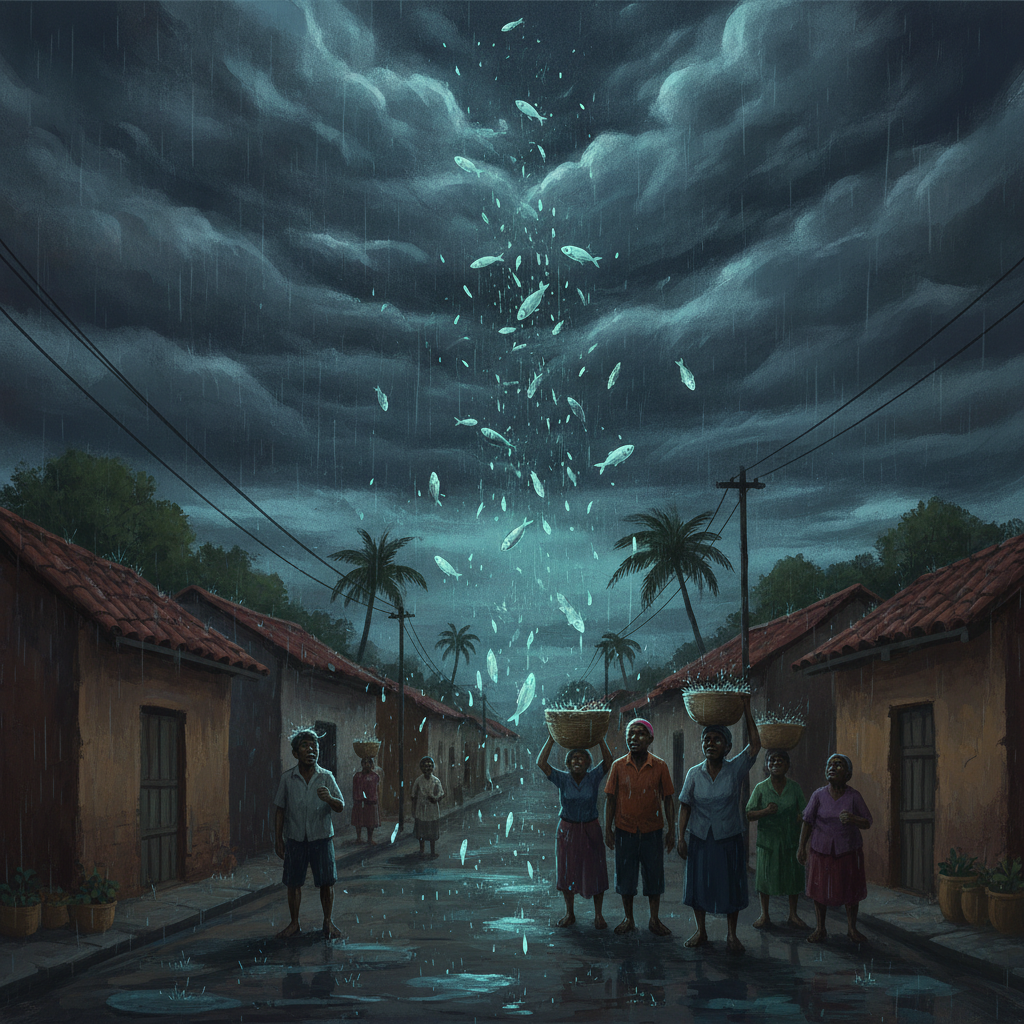
Rain of Fish: The Honduran Town Where Fish Fill the Streets After the Storm
The storm arrives the way the early summer storms always arrive in the highlands of northern Honduras. A wall of grey rolls in off the mountains, the light drains out of the afternoon, and the rain comes down hard enough to turn the unpaved streets of Yoro into running mud. Then, as abruptly as it began, it stops. Water drips from the eaves. The air smells of wet earth. And the people of this small farming town open their doors and step outside to see what the storm has left behind.
The ground is moving. Scattered across the mud and the puddles, flapping in the gutters and the roadside ditches, sometimes by the hundred, lie small silver fish, alive and gasping, far from the nearest river. Children run for buckets. Neighbours come out with baskets and cooking pots. Within an hour the fish have gone from the street into the kitchens, where they are cleaned and fried like any other catch. The townspeople call this the lluvia de peces, the rain of fish, and they say the words without irony and without much surprise, because in Yoro it has happened for as long as anyone alive can remember.
For a poor farming town in the interior of Honduras this is not a curiosity to be photographed and forgotten. It is food. A family that owns no boat and lives a long walk from any river finds a free harvest of protein lying in the road, and takes it. That practical fact matters for understanding the story, because it is the reason the event was never merely observed in Yoro. It was gathered, cooked, eaten and remembered, year after year, until it became part of the calendar of the place.
By local reckoning the fall happens once or twice a year, and some residents put it as high as three or four times. It is always tied to the season of the first great rains of May and June, and always to a single violent downpour rather than to a long spell of steady weather. There are no reliable records of when the phenomenon began. There is no municipal register of dates, no parish logbook, no run of newspaper reports going back to the beginning, only the certainty of the oldest residents that the same thing happened to their parents and to their grandparents before them. What can be said with confidence is that the tradition is well over a century old.
Since 1998 the town has stopped merely enduring its yearly oddity and started celebrating it. The Festival de la Lluvia de Peces is a parade and carnival timed to the first heavy downpour of the season, with music, food stalls and processions through the streets. Effigies of a long dead priest are carried through the town at its centre. That priest is the reason Yoro understands the event the way it does, and he is a real historical figure rather than a folk invention.
Father Jose Manuel de Jesus Subirana was a Spanish Catholic missionary who arrived in Honduras in 1855 and died there in 1864. He is remembered across the country for his work among the rural poor, and he travelled through the Yoro region in the 1850s, when it was one of the hungriest districts in a hungry country. The story the town tells is that Subirana was so moved by what he saw that he prayed for three days and three nights, asking God to send the people food. The rain of fish, in the town's account, is the answer to that prayer, arriving every wet season for more than a century and a half. Whatever one makes of it, the tradition is fixed and specific, it names a real man, and it is retold in Yoro today with complete seriousness.
The fish themselves are consistent from one fall to the next, and their description is one of the few technical details on which every account agrees. They are small, roughly the length of a hand or less, silver, and locals compare them to sardines. They are freshwater fish, not marine ones. They arrive alive, still moving, and they arrive scattered widely rather than heaped in one spot, sometimes across several streets of the town at once. Estimates of number are informal but consistent, and they run to the hundreds in a single event.
The geography is equally consistent, and it is unusual. Yoro sits well inland, in mountainous country, at a considerable distance from the coast. There is no large lake or lagoon in the immediate vicinity, and no body of water sitting directly above the town in any meaningful sense. The nearest significant drainage is the basin of the Aguan river. The town is built on the valley floor, and the ground beneath the valley includes porous rock carrying groundwater. During the first heavy rains of the season, low lying ground in and around the town floods readily.
One further point of documentation deserves stating plainly, because it shapes everything else. The consistent, repeated, verifiable observation at Yoro is that live freshwater fish are found on the ground after a heavy storm. That is what residents describe, that is what visitors photograph, and that is what the festival commemorates. There is, however, no well documented case of an outside scientific observer standing in a Yoro street during the storm and recording the fish descending through the air. The fish on the ground are attested. The falling has not been captured under controlled observation.
Animals falling from the sky is not, in itself, a disputed idea. Reports of creatures tumbling out of storm clouds go back to antiquity and have come from nearly every inhabited continent. Falls of frogs and toads in particular have been recorded for centuries, and modern cases have been documented in detail. In 2005 small frogs came down over parts of Serbia in what meteorologists treated as a textbook case. Some famous events in this category have turned out to be something else on close inspection. The eerie rain of spiders filmed in Brazil and in Australia was not a fall at all but mass ballooning, in which large numbers of spiders travel on threads of silk carried by the wind. Those cases were watched, measured and explained. Yoro, by contrast, has been celebrated, prayed over and told about for more than a hundred years, and remains, in the strict sense, unmeasured.
Conclusions and Open Questions
Three explanations compete for the rain of fish, and each has a serious weakness.
The first is the miracle of Father Subirana, held by the town itself and woven into its Catholic tradition. Its strength is that it is anchored in a genuine historical missionary and in an unbroken local memory. Its weakness is that it is a statement of faith rather than of evidence, and that it says nothing about physical origin. A prayer answered in 1856 still leaves open the question of where a particular fish was five minutes before it landed in the street.
The second is the waterspout, which is the standard meteorological account of animal falls and is broadly accepted by meteorologists for the phenomenon in general. A waterspout or a powerful storm updraft passes over shallow water, lifts water and anything light enough to be carried with it, transports the load some distance overland, and drops it when the winds weaken. The weakness here is specific to Yoro. The town is inland and mountainous with no obvious water body for a spout to empty. Waterspout falls elsewhere are one off surprises that almost never repeat in the same place, whereas Yoro's are regular enough to schedule a festival around. And the fish are freshwater and of one kind, rather than the mixed marine catch a sea spout would deliver.
The third is an underground flood. Some investigators argue that the fish never fall at all, and that Yoro is flooded from below rather than rained on from above. On this reading the fish are a freshwater species living in the water table or in subterranean streams in the porous rock beneath the valley, connected to the Aguan basin. Torrential rain saturates the ground, rising water forces its way up through fissures and low ground, and the fish are stranded in the streets as the flood recedes. This elegantly solves the regularity and the freshwater problem. Its weakness is evidential. The most cited support is an account of a team said to have been sent by the National Geographic Society in the 1970s, which reportedly found that the fish were all one freshwater species and that they were blind, with undeveloped eyes, as though they had lived permanently underground. That report has never been traced to a peer reviewed publication. It is endlessly repeated and never quite sourced, so the strongest natural theory rests partly on the weakest evidence.
One theory holds that Yoro is really two phenomena wearing one name: rare genuine sky falls during storms violent enough to spawn a spout somewhere upriver, and much commoner strandings of groundwater fish in flooded streets. A community that has decided its yearly fish are a miracle would have no reason to separate the two.
What remains unexplained is the mechanism, and the open questions are concrete. Where would a waterspout draw fish from, given Yoro's position? Why does the event repeat on a seasonal schedule when comparable falls elsewhere do not? What species are the fish, and has anyone examined them for the traits of subterranean life? And above all, has anyone ever actually seen them fall? Until a patient observer with a camera stands in a Yoro street during the right storm, the gap between finding fish and watching them descend is where this mystery lives.