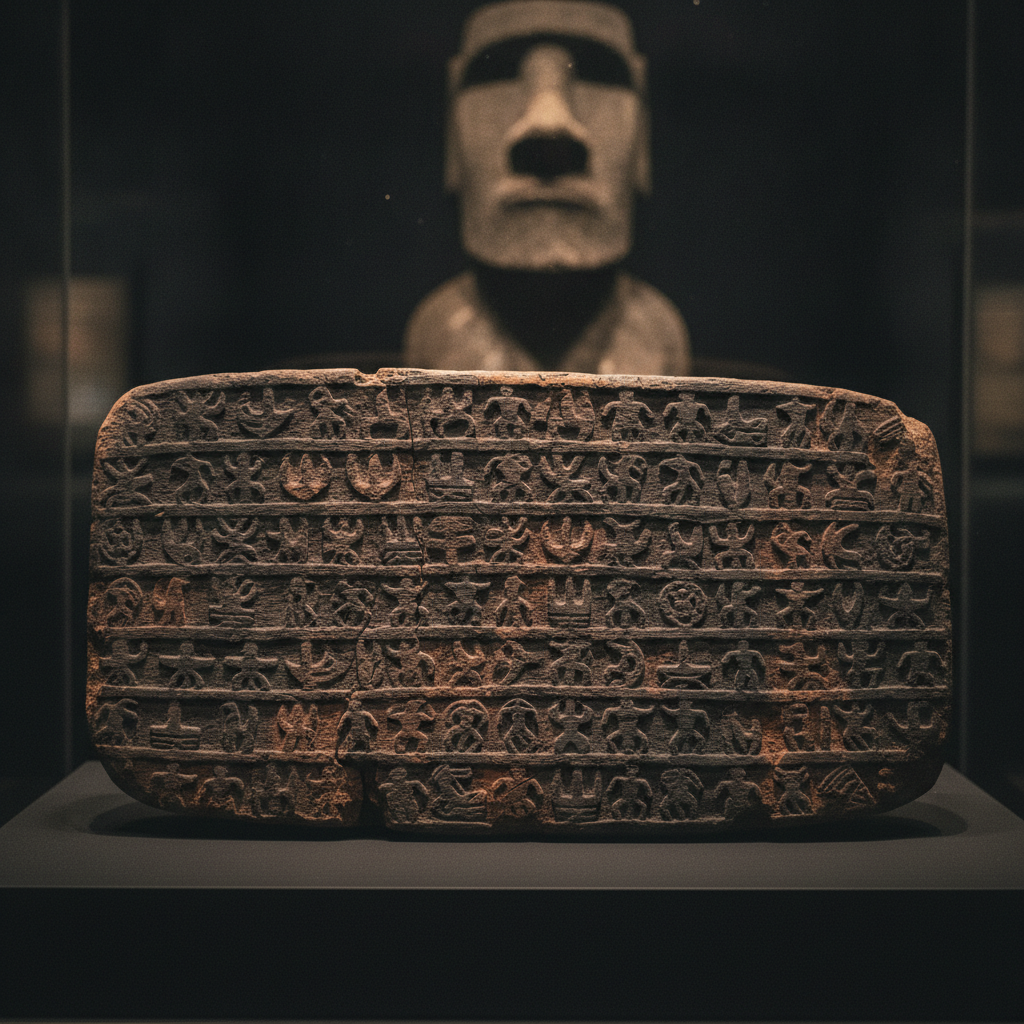
Rongorongo: The Script That Died With Its Readers
Rapa Nui, the island the outside world learned to call Easter Island, is a volcanic speck in the South Pacific, roughly 3,500 kilometres west of the Chilean coast and more than 2,000 kilometres from the nearest inhabited land. At some point before the middle of the nineteenth century, people there were carving rows of tiny figures into flat wooden boards: birds with human arms, fish, plants, seated men, crescents, spirals, and shapes that resemble nothing else on earth. The islanders called the objects kohau rongorongo, roughly the boards for reciting or chanting. About two dozen of them survive today. No living person can read a word of them.
The end of the reading tradition can be dated closely, and it was violent. In December 1862 and through 1863, Peruvian slave ships raided Rapa Nui and carried off something on the order of 1,500 people, among them the king, his heir, and much of the priestly and learned class. International protest forced a repatriation. Of the handful who survived the return voyage, several carried smallpox, and the epidemic that followed, layered on top of the abductions, hollowed out the island. By the 1870s the population had fallen to little more than a hundred people. Whatever chain of teachers and students had carried the script from one generation to the next was broken within a single decade.
The first outsider to describe the tablets arrived just after the collapse. In the winter of 1864 a French lay brother named Eugene Eyraud stepped ashore, intending to convert the islanders. In hut after hut, he reported, he found flat wooden boards, polished smooth and covered edge to edge with rows of carved signs. Almost every household seemed to own one, and the islanders chanted from them at festivals, though Eyraud suspected that even then few of them grasped what the signs meant. He collected none. Within roughly ten years almost all of the boards were gone, burned as fuel, buried with their owners, or simply lost.
In 1868, Bishop Florentin Etienne Jaussen of Tahiti realised what the tablets might be and began to gather what remained. He also looked for someone who could still read them. He found a Rapanui man named Metoro Tauaure, who would take a tablet, turn it in his hands, and sing. Metoro's chants were transcribed at length, but they never matched from one reading of the same tablet to the next, and when he was handed a tablet upside down he sang on undisturbed. A later informant, an old man called Ure Vaeiko, refused to have the tablets themselves put in front of him and recited instead when shown photographs of them. Those two performances are the closest thing to a living reading of rongorongo that was ever recorded.
The surviving corpus is small. Perhaps twenty-six or twenty-seven genuine objects remain, depending on how the fragments and the pieces of reused driftwood are counted, scattered across museums from Santiago and Honolulu to London, Vienna, and Saint Petersburg. Together they carry something over ten thousand glyphs. They are written in a system called reverse boustrophedon: the lines run left to right, but every second line is inverted, so a reader who reaches the end of a row must rotate the entire tablet 180 degrees to carry on with the next.
The objects themselves are not uniform. Most are shaped planks, but the corpus also includes fragments of reused driftwood, a wooden staff, two crescent shaped pectoral ornaments, a birdman figure and a small snuff box, all carrying the same signs. One of the largest tablets, Tahua, is carved on the blade of a European ash oar, which means at least some surviving texts were cut after contact with outside ships.
The physical work involved was considerable. The glyphs were cut into hard tropical woods, most often the fine-grained toromiro and the Pacific rosewood that botanists call Thespesia populnea, using flakes of black obsidian and, on some pieces, the tooth of a shark. The longest single text, the object known as the Santiago Staff, is a wooden sceptre carrying roughly two thousand signs in a tight, unbroken procession. The strokes are regular, the spacing is deliberate, and the figures repeat with a consistency that indicates rules and training rather than decoration. Rapanui tradition names a class of specialists who produced and used the boards, the tangata rongorongo, the men of the reciting boards, and they were among the groups destroyed by the raids and the epidemic.
One passage, and essentially only one, has yielded to modern study. On the tablet known as Mamari, the linguist and code breaker Jacques Guy identified a sequence built around crescent shapes that tracks the nights of the old Rapanui lunar month: a lunar calendar carved in wood. It is the single stretch of rongorongo whose subject is generally agreed upon. What it says in detail, and what the remaining ten thousand signs say, is unknown.
The basic reference tool for all of this work dates from 1958, when the German ethnologist Thomas Barthel published the first full catalogue of the script, assigning roughly six hundred numeric codes to the signs and their variants. Every subsequent study, whatever its conclusions, has been built on top of that catalogue.
Then, in early 2024, a team led by Silvia Ferrara, a philologist at the University of Bologna, radiocarbon dated four tablets held in Rome and published the results in the journal Scientific Reports. Three behaved as expected: the tablets known as Tahua, Aruku Kurenga, and Mamari were cut from wood felled between the late seventeenth and the nineteenth centuries. The fourth, a battered board called Echancree, was made from wood with a felling date of roughly 1493 to 1509, more than two hundred years before the Dutch admiral Jacob Roggeveen sighted the island on Easter Sunday, 1722. The authors stated the caveat plainly in the paper: radiocarbon dates the tree, not the carving, and the wood may have been driftwood of a non-native species that arrived on the island already old.
That is the documented record. A script of more than ten thousand signs, about two dozen surviving objects, one agreed calendar passage, one anomalous date, two recorded performances by men who could not demonstrably read, and no reader left alive.
Conclusions and Open Questions
Almost everything beyond that record is argument, and every serious proposal so far carries a weakness of its own.
Barthel's 1958 catalogue remains indispensable, but critics have long noted that his code assignments are inconsistent, and that deciding where one sign ends and the next begins is itself partly guesswork. A corpus segmented by different rules produces a different script, which means the raw material of every analysis is already an interpretation.
In 1957 the Soviet scholars Nikolai Butinov and Yuri Knorozov, the latter fresh from his work on Maya glyphs, argued that a repeating structure on one tablet looked like a genealogy, a list of the form son of, son of. The observation was shrewd, but it could never be tested against any known Rapanui lineage, and it decoded nothing.
In 1995 Steven Fischer announced that the long inscription on the Santiago Staff was a creation chant, endlessly repeating a formula he read as one thing joined with another and there issued forth a third. The reading is internally neat, but the special mark on which his whole scheme depends is largely missing from the other tablets, so the pattern cannot be generalised, and most specialists have set it aside.
More cautiously, the linguist Konstantin Pozdniakov used statistical analysis of the corpus to argue that the real inventory of distinct signs is far smaller than Barthel's hundreds, on the order of a few dozen basic units that combine and fuse. That would fit a syllabary, a script recording sounds, and it is arguably the most promising line of attack. It has still not allowed anyone to read a single new sentence.
Behind all of these sits the largest disagreement of all: whether rongorongo is writing at all. One camp holds that it is true writing, encoding the Rapanui language sign for sound, and is simply waiting for a bilingual key. The other holds that it is proto-writing, an elaborate prompt system for chants, genealogies, and rites on which a trained man could hang his memory, but which never fixed language tightly enough for a stranger to read it cold. The strength of the mnemonic theory is that it explains Metoro and Ure Vaeiko without embarrassment. Its weakness is that it may be a counsel of despair, an excuse for the failure to decipher, and if it is correct there is nothing to decipher at all.
The 2024 date has opened a further set of theories rather than closing any. Some argue that it supports independent invention: that a few thousand people on the loneliest inhabited land on the planet created writing from nothing, one of only a handful of such events in human history. Others reply that driftwood arriving already centuries old would produce exactly the same result, so the date says nothing certain about the age of the script. One theory holds that the surviving boards are late copies of a much older tradition whose beginnings simply rotted away in a climate that devours wood. Another holds that the system was still mid-invention, drifting from memory aid toward full writing, when the slave ships ended the drift.
What remains unexplained is easy to state and hard to solve. There are no primitive tablets in the corpus, no false starts, no simplified early versions; the script appears already mature and consistent. No one can explain how a laborious, standardised system was forgotten so completely that within one generation nobody could say what it meant. And decipherment normally requires a living reader, a bilingual text, or a corpus large enough to expose the pattern. Rapa Nui offers none of the three. The honest position is that we do not know, and may be structurally unable to know.