The Day the Sky Exploded: Siberia's Tunguska Enigma
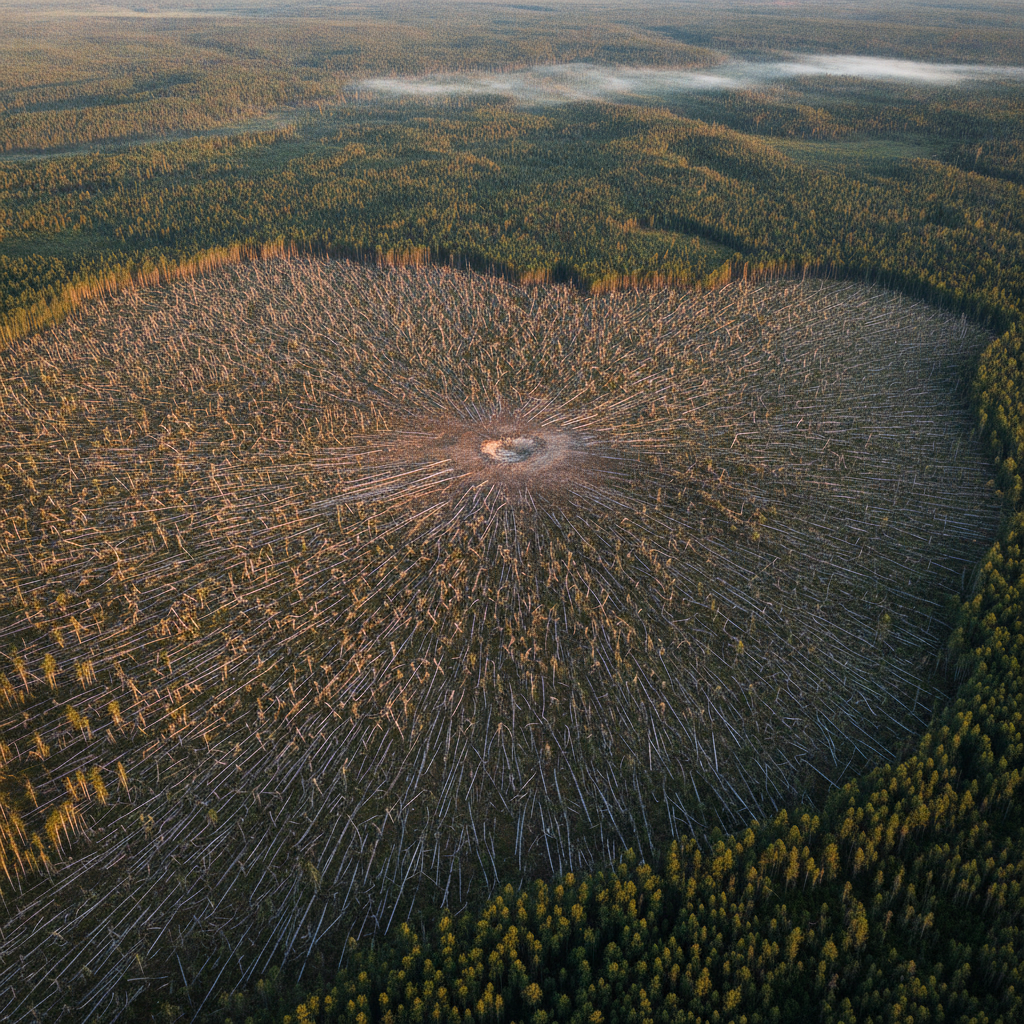
At around 7:14 on the morning of June 30, 1908, the sky above a remote stretch of Siberian taiga tore open. A fireball described by witnesses as brighter than the sun streaked across the basin of the Podkamennaya Tunguska River and, without ever touching the ground, detonated in midair. In an instant, roughly 2,000 square kilometers of ancient forest, an estimated 80 million trees, were flattened like matchsticks and splayed outward in a vast radial pattern that pointed back toward a single point in the sky.
The people who lived nearest the blast survived to describe it. At the Vanavara trading post, some 65 kilometers from the epicenter, a man named Semen Semenov was sitting on his porch when, he said, the sky split in two and the whole northern horizon seemed to catch fire. He felt a wave of heat so intense that he thought his shirt was burning, and an instant later a shock wave threw him several meters from his chair and knocked him briefly unconscious.
Nomadic Evenki herders in the area gave similar accounts. They described tents hurled into the air, reindeer scattered and killed, and a thunder that rolled on and on across the taiga. Windows shattered in settlements hundreds of kilometers away.
The event also registered on instruments far beyond Russia. Seismographs as distant as Western Europe recorded the tremor. Barometers traced the pressure wave twice around the planet. For several nights afterward the skies over Europe and Asia glowed so strangely that people reported being able to read a newspaper outdoors at midnight, and the unusual brightness was noted in observatory records and newspaper columns of the time.
And then, for almost two decades, almost nothing. The explosion had struck one of the most inaccessible corners of the Russian Empire, hundreds of kilometers from the nearest town, and the years that followed brought the First World War, revolution and civil war. No scientific party reached the site while the fallen forest was fresh.
It was not until 1927, nineteen years after the event, that the mineralogist Leonid Kulik managed to lead the first scientific expedition to the location. Kulik was convinced he would find a giant crater and the buried remains of a colossal iron meteorite, potentially a fortune in metal for the young Soviet state.
What he found was different. At the very center of the devastation the trees were still standing upright, but stripped almost completely of their branches and bark, like a forest of blackened telegraph poles. Around this standing grove, for kilometers in every direction, millions of trees lay pointing outward. And nowhere, no matter how hard Kulik and later teams searched, was there a crater.
Kulik returned to that desolate place again and again over the following years. He took the first photographs of the stripped and fallen forest, drilled and dug in the boggy hollows he suspected of hiding buried fragments, and in the 1930s arranged aerial surveys that captured the radial devastation from above. He never found the crater he was certain existed, nor a single meteorite worth the name. He died in 1942 in a German prisoner of war camp.
Later Soviet expeditions in the 1950s and 1960s mapped the full zone of destruction. It was not a neat circle but a great butterfly shaped scar, stretching much farther in one direction than another. From that shape, and from the alignment of the fallen trunks, researchers estimated that the object had come in from the southeast on a shallow, slanting path.
The absence of a crater, once puzzling, became the key to the physics. The pattern of standing central trees surrounded by radial fall showed that the object never reached the ground. It exploded in the air, some five to ten kilometers up, and the blast came down on the forest from almost directly above, snapping the branches off the trees beneath the burst while flattening everything farther out. This is an airburst, and it is now the established explanation for what happened over the Tunguska.
The mechanics are well understood. A body perhaps 50 to 60 meters across entered the atmosphere at tens of kilometers per second. Air resistance crushed and heated it until it disintegrated, and it released its enormous kinetic energy all at once as a fireball and a pressure wave. Estimates of that energy range from roughly 10 to 30 megatons of TNT, hundreds of times the yield of the bomb dropped on Hiroshima. It remains the largest impact event in recorded human history.
The physical traces recovered from the site are real but very small in scale. Researchers sifting the soil and peat around the epicenter, and picking through the resin trapped in surviving trees, have reported microscopic spheres of silicate and magnetite, some with a high nickel content of the kind associated with meteoritic material rather than ordinary earth. Analyses of peat layers laid down around 1908 have turned up elevated concentrations of iridium, an element rare in the Earth's crust but comparatively common in asteroids and comets. These are traces of dust, not debris. Despite more than a century of searching, dozens of expeditions and countless soil samples, no confirmed, sizeable fragment of the object has ever been recovered.
Modern science has since watched a smaller version of the same event happen live. On the morning of February 15, 2013, an asteroid only around 17 to 20 meters wide exploded over the Russian city of Chelyabinsk with an energy of roughly half a megaton. It shattered windows across the region and injured more than 1,500 people, most of them cut by flying glass as they rushed to their windows to see the blinding trail overhead. Chelyabinsk was a small fraction of Tunguska's power, and the airburst itself left no crater, only a scatter of small meteorites and a great deal of broken glass. Recorded by hundreds of dashboard cameras and measured by seismic and infrasound instruments, it gave scientists their first well documented look at the physics of an atmospheric explosion.
The Tunguska event is now recognized as a benchmark for that hazard. The United Nations marks June 30, the anniversary of the blast, as International Asteroid Day.
Conclusions and Open Questions
The airburst is settled. What the object was made of is not, and the debate has run for decades.
The asteroid camp points to the nickel rich, iridium bearing microspherules and to the sheer local violence of the blast, and argues for a dense, stony body that shattered high in the air. Its weakness is the near total absence of macroscopic meteoritic fragments, which a stony asteroid might be expected to scatter across the impact zone.
The comet camp, associated with the Soviet astronomer Vasily Fesenkov and others, answers that the object left no rock precisely because it was mostly ice and dust, a fragile lump of frozen volatiles that vaporized completely in the fireball. Some proponents go further and tie Tunguska to Comet Encke and the Beta Taurid meteor stream, noting that the timing and the apparent direction of arrival fit a fragment shed by that comet. This theory explains the empty ground, and the dust it would have injected high into the atmosphere would account for the luminous European nights. Its weakness is the microspherules and the iridium, which look more like the signature of a rocky body, and the immense energy delivered so low in the sky, which many modelers find easier to reconcile with a denser stone.
One line of research has claimed to find the missing fragment. In 2007 an Italian team argued that Lake Cheko, a small, oddly deep, funnel shaped lake about eight kilometers north northwest of the epicenter, might be a hidden impact crater gouged by a surviving piece of the object. That would be the physical evidence everyone has hunted for a century. Later studies of the lake's sediments suggested it may well predate 1908 altogether, and the claim remains contested rather than confirmed.
Around these sober disputes has always swirled a fog of stranger proposals, and they deserve to be weighed honestly. In 1965, Nobel laureate Willard Libby and colleagues floated the idea that a chunk of antimatter had annihilated in the atmosphere; the notion foundered because such an event should have left a distinct radioactive fingerprint that was never convincingly found. In 1973, physicists Albert Jackson and Michael Ryan proposed that a tiny black hole had passed through the Earth, but a black hole entering over Siberia should have punched out again somewhere in the North Atlantic, and no such exit event was ever recorded. Others still argue for Nikola Tesla's imagined death ray or the crash of an alien spacecraft, ideas that carry no physical evidence at all and survive largely because they can never quite be disproven. Each of these theories has the same shape: it explains the drama and ignores the data.
What remains genuinely unexplained is narrower than the wilder claims suggest, and more stubborn. Was the Tunguska object a stony asteroid or a fragment of a comet? What exactly was it made of, and how large was it really? Why, across 2,000 square kilometers of shattered and scorched forest, did it leave behind not a single unambiguous piece of itself, only microscopic dust? One theory holds that there was never much solid body to recover, that a loosely bound rubble pile or an icy comet fragment did exactly what physics says such a thing should do and unmade itself entirely in a single flash. If that is right, the largest cosmic impact in recorded history will remain what it is today: a case reconstructed almost entirely from the direction in which the dead trees fell.