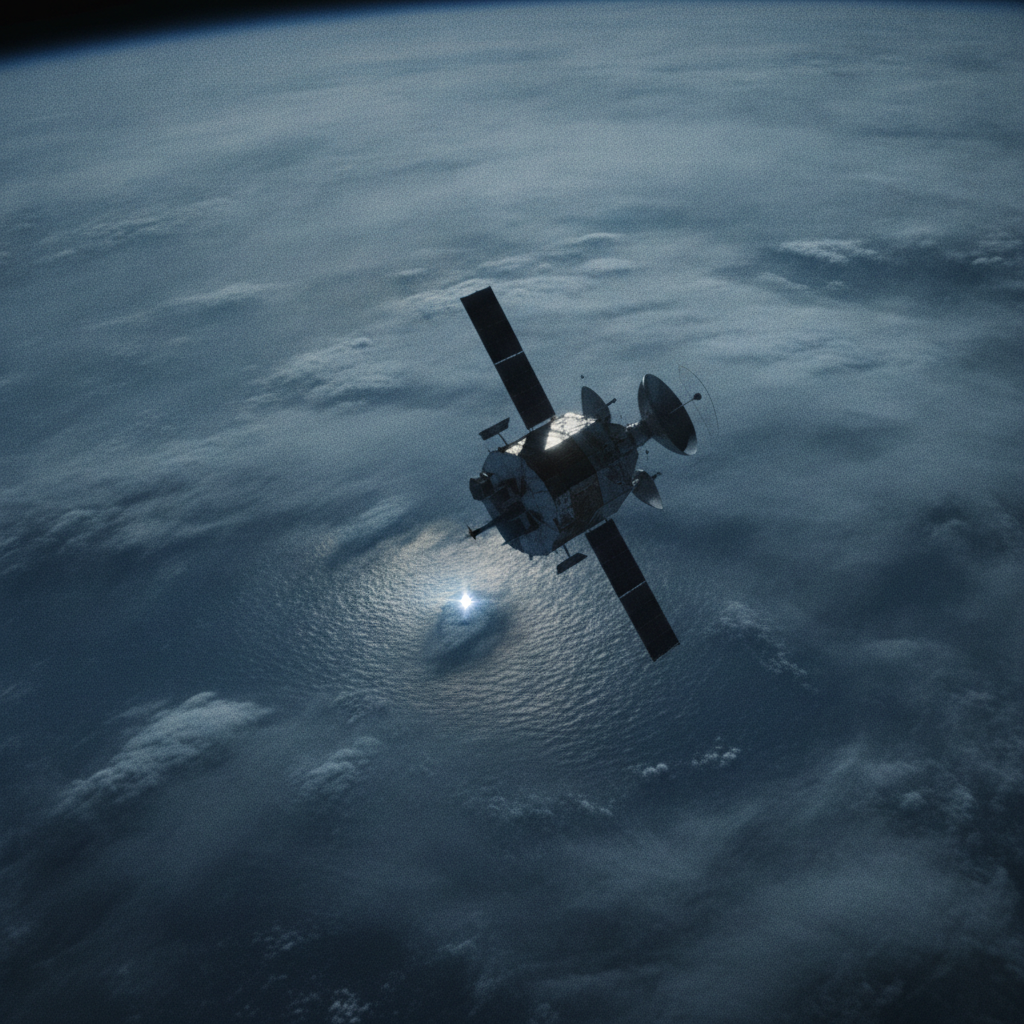
The Double Flash: What the Vela Satellite Saw Over the Southern Ocean
The satellite that saw it was already old. Vela 6911 had gone up in May 1969, into an orbit so high that it could watch nearly half the planet at once, and by the autumn of 1979 it was more than two years past the end of its design life. Its job was simple and enormous: to watch the Earth and the space around it for the light of a nuclear explosion, so that nobody could set one off in the atmosphere without the United States knowing. At 53 minutes past midnight, Greenwich Mean Time, on 22 September 1979, over an empty stretch of the southern ocean between Africa and Antarctica, it recorded exactly that.
The instruments that made the recording were two small silicon light sensors with an odd name. They were called bhangmeters, after the Indian cannabis preparation bhang, on the joke that only someone under its influence would believe such a device could work. What they measured was the shape of light over time. A nuclear fireball has a signature almost nothing else in nature produces: a fierce first spike lasting about a thousandth of a second, then a dip as the expanding shock front turns opaque and hides the fireball behind it, then a second pulse, slower and brighter and far longer, as the shock front thins and the fireball shines back through. That is the double flash. In the sixteen years the Vela satellites had been in service they had recorded it forty-one times. Every one of those forty-one had been a nuclear test.
Hai usato le tue letture gratuite di questo mese.
Sblocca tutti i 227 misteri documentati - in 8 lingue, senza pubblicita.
Accesso completo