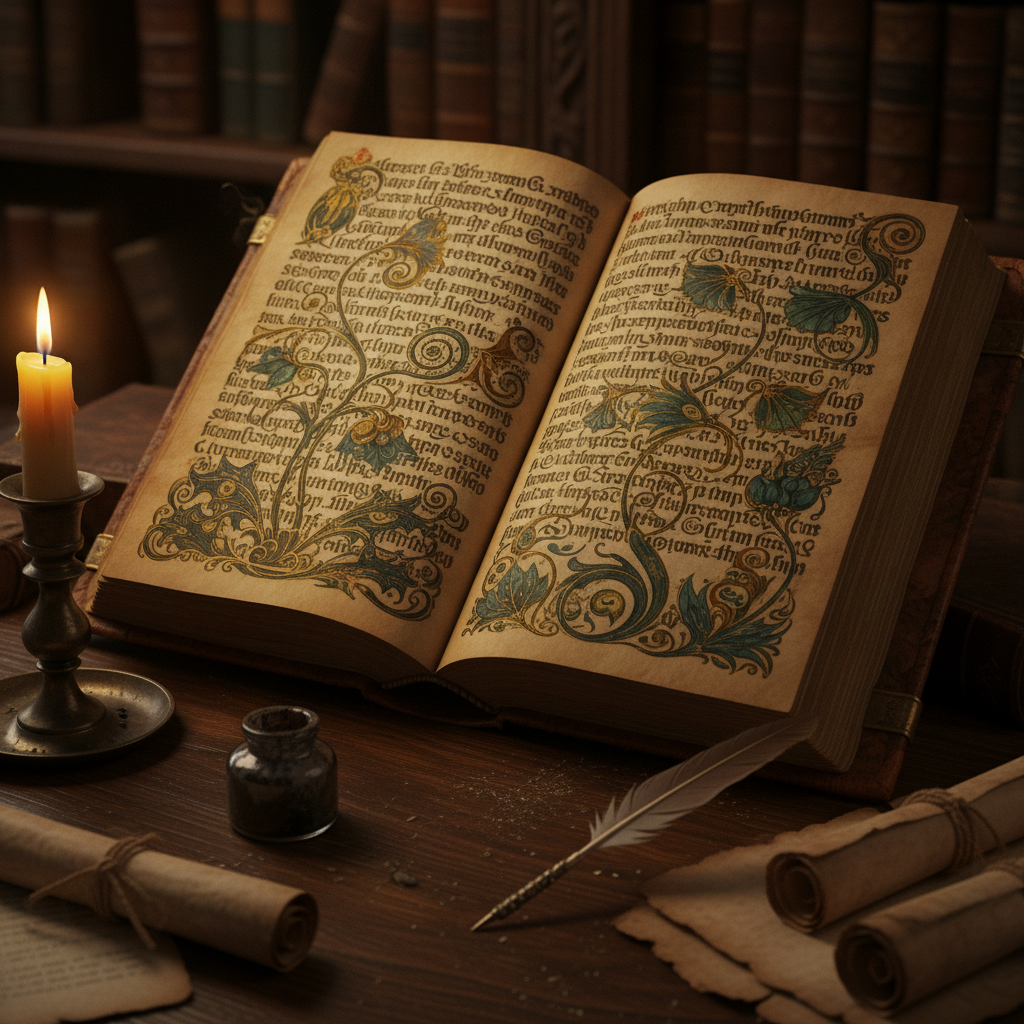
The Book No One Can Read: Six Centuries of the Voynich Manuscript
In 1912 Wilfrid Voynich, a Polish revolutionary turned London antiquarian, travelled to the Jesuit college at the Villa Mondragone outside Rome to buy manuscripts the order was quietly selling. Most of what he handled that day was ordinary. One book was not. Its vellum was soft and yellowed, its binding plain, and across every page ran a script he could not identify, looping and fluent, interrupted by drawings of plants that matched no known species and of naked women standing in pools of green liquid connected by strange pipes. He spent the rest of his life trying to read it and never did.
The book Voynich carried out of Italy now rests in a climate controlled vault at Yale University, catalogued as Beinecke MS 408. It has been fully digitized and can be paged through free of charge by anyone in the world. Not one sentence of it has ever been read in a way that specialists accept.
Physically it is a small codex of roughly 102 surviving leaves of calfskin vellum, folded into eighteen gatherings, several of which open out into wide foldout panels. The page numbering, added by a later hand, shows that at least fourteen leaves are missing. Scholars divide the surviving pages into loose sections according to their illustrations: a herbal of unidentifiable plants, an astronomical part crowded with suns, stars and zodiac roundels, a so called balneological section in which small naked figures wade through green pools and looping tubes, a pharmaceutical run of jars and severed roots, and a closing block of dense text marked only by tiny stars in the margin.
The writing itself, which researchers call Voynichese, covers about 240 pages. It runs left to right in an even, practised hand with almost no crossings out or corrections. Certain characters cluster at the beginnings of words, others only at the ends. Some word shapes appear in one section of the book and never in another. Words that are nearly identical often sit side by side. Whatever it is, it was written fluently, by people who were not hesitating over what to put down.
For a long time the obvious suspicion was that the whole thing was a modern forgery, and Voynich himself, a dealer with everything to gain, was the natural suspect. That question was settled in 2009, when a team at the University of Arizona radiocarbon dated the vellum to between 1404 and 1438. The parchment is genuinely of the early fifteenth century, made long before Voynich was born.
The ownership history can be traced back in fragments almost as far. Under ultraviolet light scholars recovered an erased signature on the first page belonging to Jacobus Horcicky de Tepenec, court physician to the Holy Roman Emperor Rudolf II. From him the trail leads to Georg Baresch, a Prague alchemist who puzzled over the book for years, and then to his friend Johannes Marcus Marci, rector of Charles University, who in 1665 sent it to the Jesuit scholar Athanasius Kircher in Rome with a covering letter. That letter passes on a report that Rudolf had once paid 600 ducats for the volume, believing it to be the work of the English friar Roger Bacon. The letter is genuine; the story inside it has never been independently confirmed.
The manuscript has defeated the best codebreakers of the twentieth century. William Friedman, whose team broke the Japanese Purple cipher in the Second World War, worked on it on and off for more than three decades, joined by his wife Elizebeth, herself one of the leading cryptanalysts of the age. Both gave up without a solution. Friedman recorded his final guess inside an anagram so that he could claim priority if it were ever confirmed: that the text might be an artificial language built on some early philosophical scheme. He never proved it. Analysts at the National Security Agency, professional linguists and generations of skilled amateurs have worked on the book since, without result.
Computers have added measurements rather than answers. The text obeys Zipf's law and other statistical fingerprints of natural human language, the kind of deep regularity that is difficult to produce by hand. At the same time its word structure is unlike any documented language, with its heavy repetition and its section bound vocabulary. Both findings are well established and they pull in opposite directions.
Announced solutions have arrived regularly and have not survived review. In 2018 an artificial intelligence study from the University of Alberta made headlines by declaring the text to be encrypted Hebrew; specialists took the claim apart within days. In 2019 Gerard Cheshire, an honorary research associate at the University of Bristol, announced that the manuscript was written in a proto-Romance language and said he had cracked it in a matter of weeks. Linguists rejected it, and the manuscript scholar Lisa Fagin Davis described the work as circular and aspirational rather than evidence based.
The firmest recent progress has come from the object itself. In 2020 Fagin Davis concluded from the handwriting that at least five different scribes shared the work, meaning the book was produced by a team rather than by one isolated eccentric. In 2024 multispectral imaging of the first page revealed faded columns of ordinary Roman letters set beside Voynich characters, apparently an early reader's attempt to build a key, later scrubbed away. A much discussed reading published the same year argued that the bathing scenes deal with women's medicine and sexuality, a plausible medieval subject, though it too stops short of producing a readable sentence.
Six hundred years after the vellum was cut, the position is unchanged in the only respect that matters. The book is available to everyone, its statistics have been measured to death, and nobody can say what a single word of it means.
Conclusions and Open Questions
Four things are established. The vellum dates to the early fifteenth century. At least five scribes wrote the text. The writing carries the statistical signature of a real language. And no proposed reading has ever been reproduced or accepted. Everything else is theory.
The oldest theory holds that Voynichese is a cipher, ordinary language dressed in code. It was the working assumption of Baresch, of the Friedmans and of most cryptanalysts who followed. Its strength is the disciplined, language-like structure of the writing. Its weakness is blunt: no proposed cipher has ever produced sustained, sensible text, and a fifteenth century encryption strong enough to defeat modern computing would be a historical marvel with no other surviving example anywhere.
A second camp argues that the text is a real but lost or exotic natural language, written phonetically in an invented alphabet. This explains the statistical naturalness cleanly. It founders on the details: no known language repeats near identical words side by side the way this one does, or confines particular word shapes to particular sections of a book.
Friedman's own preference was for a deliberately constructed language, an artificial tongue of the kind a few Renaissance scholars did attempt, in which whole categories of meaning are folded into the shape of each word. It satisfies both the statistics and the absence of a cipher. Its weakness is chronology: the great philosophical languages of that type belong to the seventeenth century, decades after this vellum was cut, and no source records anyone attempting such a project so early.
The hoax theory says the book means nothing at all. In 2004 the computer scientist Gordon Rugg showed that a simple grille and table method could generate convincingly Voynich-like text. Torsten Timm and Andreas Schinner later proposed a self citation process, in which a scribe produces each new word by copying and slightly altering a word already on the page, which reproduces the Zipf statistics. Its strength is that it requires neither a lost language nor an unbreakable code. Its weakness is motive and cost: years of labour and a small fortune in vellum for a book designed to say nothing, sustained without a slip across 240 pages and shared out among five scribes.
Some argue for a middle possibility: that the book was written in earnest in a private system, a personal shorthand or mnemonic notation devised by one mind and meant to be read by its author alone. One theory holds that this would explain why the sharpest cryptanalysts found nothing to break, since there would be no lock, only a notation whose key died with its maker. Its weakness is that it cannot be tested; it predicts exactly the situation we already have.
What remains unexplained is not only the script. No one has identified the plants, which appear to be composites of real parts assembled into species that do not exist. No known medical or mythological tradition matches the plumbing and pools of the bathing section. Fourteen leaves are missing and nobody knows what was on them. And someone, early on, sat down with the book and tried to build a key from Roman letters, then erased it, and we do not know who or what they concluded.
The open questions are simple to state and unanswered. Who commissioned a book expensive enough to require a team of scribes? What was the book for, if its owner could not sell its contents or explain them? Why has no second document in this script ever surfaced, not a note, not a draft, not a single practice page? And is the Voynich manuscript unreadable because its key is lost, or because it never had one?