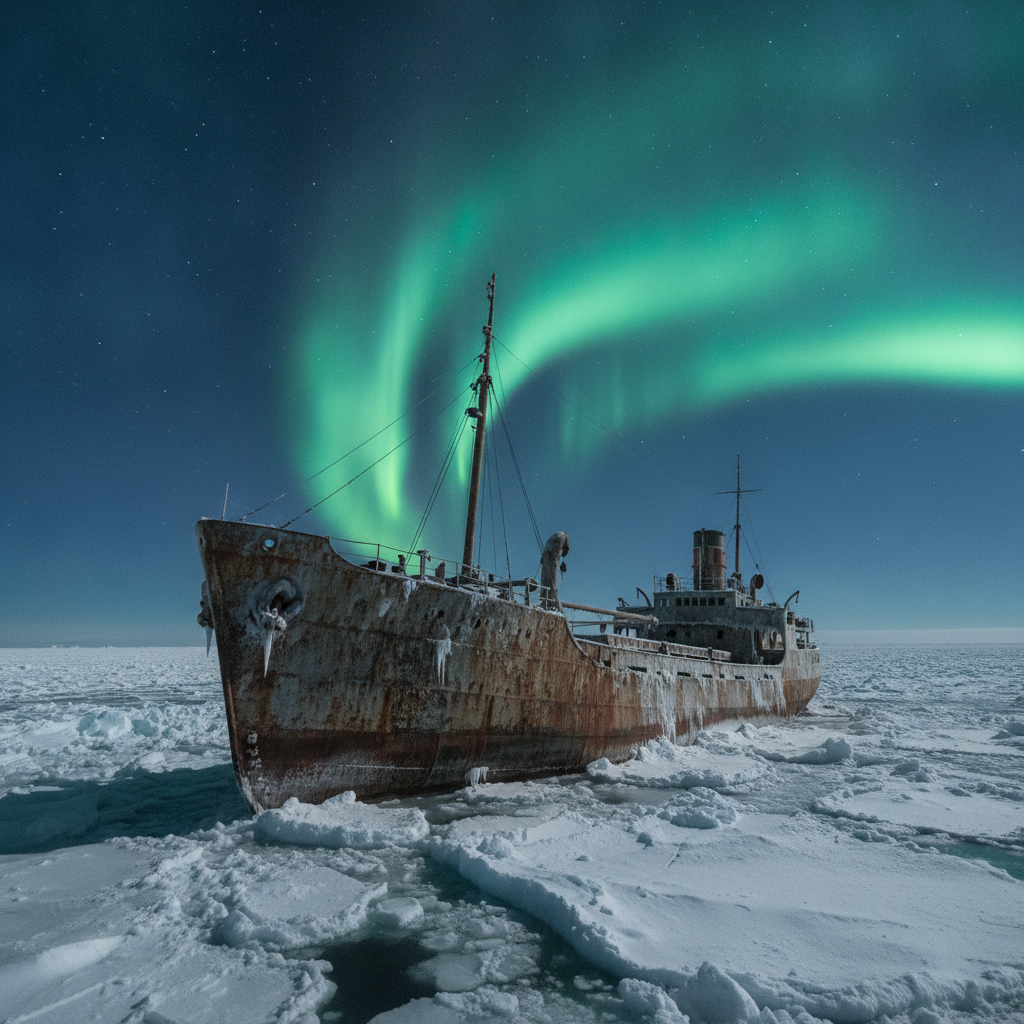
The Ship That Refused to Die: The 38-Year Ghost Voyage of the SS Baychimo
For three days at the end of November 1931, a blizzard erased the top of the world. Fifteen men - the wintering crew of the Hudson's Bay Company steamer SS Baychimo, under Captain Sydney Cornwell - rode it out in a wooden hut they had thrown together on the shore near Barrow, Alaska, the settlement now known by its Inupiaq name, Utqiagvik. They were close enough to keep an eye on their ship, trapped in the pack ice offshore. On 24 November 1931, when the storm finally spent itself and the men climbed out into the white silence, they turned toward the spot where 1,322 tons of steel had stood frozen fast. The Baychimo was gone. Not sunk before their eyes, not shattered on the beach - simply gone. Captain Cornwell concluded she had broken up and gone down in the storm. He was wrong, and the proof of how wrong would keep surfacing for the next thirty-eight years.
Until that moment she had been an entirely unremarkable ship. Launched in 1914 at the Lindholmens shipyard in Gothenburg, Sweden, under the name Angermanelfven - after a great river of the Swedish north - she was built for the Baltische Reederei of Hamburg, handed to Britain after the First World War as war reparations for shipping losses, and bought in 1921 by the Hudson's Bay Company, which renamed her Baychimo and based her in Ardrossan, Scotland. Two hundred and thirty feet of steel hull, driven by a triple-expansion steam engine at a plodding ten knots, she spent the 1920s working one of the harshest trade routes on earth - carrying provisions out to the Inuit settlements along the Victoria Island coast of Canada's Northwest Territories and coming home each season loaded with furs. Nine voyages she made, and nine times she came back. She was a workhorse, not a legend.
The tenth voyage broke the pattern. On 1 October 1931, homeward bound with a valuable cargo of pelts, the Baychimo was caught by an early freeze near Barrow. The crew abandoned her briefly, crossing half a mile of ice to shelter in the town for two days - only to find, on their return, that the ship had worked herself free. She was trapped again on 8 October, more thoroughly this time, and it became clear no one was sailing anywhere before spring. On 15 October the company sent aircraft and flew out twenty-two of the crew. Fifteen men stayed behind with Cornwell to guard the ship and the furs, and it was these fifteen who built the shore hut. It was a grim assignment: months of darkness ahead, temperatures far below zero, and a valuable cargo of pelts the company would not abandon to the ice or to scavengers. Then came the blizzard, and after it the empty stretch of ice. A few days later an Inuk seal hunter brought word that the steamer was drifting, intact, some forty-five miles down the coast. The men tracked her down, stripped the most valuable furs from her holds, judged the battered hull doomed by the coming ice, and left her to her fate. Within months she had reportedly drifted hundreds of miles from where they had abandoned her.
She was not, it turns out, entirely empty. Somewhere in her holds sat a collection of Canadian Arctic artifacts - clothing, tools, and everyday objects gathered in 1930 from Inuit communities by the explorer Richard Sterling Finnie. That detail matters, because it is the thread that makes the ghost story physical. In the years that followed, men who boarded the drifting Baychimo carried off some of Finnie's specimens; one, a crewman named Peter Palsson, later handed pieces to an Alaska College archaeological expedition, and in 1934 they were accessioned into the young University of Alaska Museum. There they sat, their origin forgotten, until researchers untangled the trail and published it in the journal Polar Record in 2016. Whatever became of the hull, part of the Baychimo's cargo can still be held in the hand, in a museum drawer in Fairbanks. The ghost left physical evidence.
What followed her abandonment reads like a folk tale, except that it is documented. In the early months of 1932 the trader Leslie Melvin found her adrift near Nome while travelling by dog team. In March 1933 a group of Inupiat boarded her, and a storm blew in and trapped them aboard the dead ship for ten days before they could get off. On 11 August 1933, the Baychimo was spotted twelve miles off Wainwright, Alaska by the crew of the small trading vessel MS Trader - and among those who climbed her rails that day was the Scottish botanist, poet and Arctic traveller Isobel Wylie Hutchison, then journeying the northern coast to collect plants. The boarding party carried off a whaleboat, some furniture, and other items from a ship written off nearly two years earlier. In July 1934 a party of explorers on a schooner climbed aboard; in September 1935 she was spotted again off the Alaskan coast. In November 1939 Captain Hugh Polson boarded her intending to salvage her, and the creeping ice floes drove him away empty-handed. The sightings continued, growing rarer, into the post-war decades; one was reported as late as 1962, in the Beaufort Sea. The last widely accepted sighting came in 1969, when a group of Inupiat saw a rusting hulk frozen into the pack between Icy Cape and Point Barrow - thirty-eight years after her crew walked away. Then nothing.
In 2006 the State of Alaska launched a project to settle the matter and find the Arctic's ghost ship - afloat, aground, or on the seabed. It found no trace. The Baychimo had been declared lost in November 1931; she spent thirty-eight years contradicting that verdict, and she has spent more than half a century since declining to confirm it.
Conclusions and Open Questions
Almost nothing about this story behaves the way ships and ice are supposed to behave, and that is the puzzle at its center. Arctic pack ice crushes hulls; it crushed the far sturdier Karluk in 1914 within months, with a full crew fighting to save her. How did an unmanned steamer - never pumped dry, never patched, never repainted - survive nearly four decades of that same ice, haunting the same few hundred miles of coastline and staying boardable season after season instead of being flushed through the Bering Strait or ground to pieces? No one has ever explained it.
Most maritime historians assume the simplest ending: the ice finally won, and she sank unseen, probably in the shallow waters of the Chukchi Sea. The strength of this view is its economy - after 1969 the sightings stop, and a sinking would explain the silence. Its weakness is the total absence of a body: no confirmed wreck, no identified debris, and a modern, deliberate search that came home empty-handed. A second school holds that she grounded and was slowly buried, entombed in the sediment of a shifting seabed or swallowed by a beach; plausible on that low, mutable coast, and just as unproven.
Skeptics offer a third reading: that some of the later sightings were misidentifications, or Arctic superior mirages - the Fata Morgana that famously conjures phantom ships above the horizon. That would tidy away the improbable longevity, but it collides with the hard record. It cannot explain the people who climbed her rails, sheltered inside her for ten days, and carried her furniture and her artifacts into a museum that still holds them. You do not sleep for a week inside a mirage.
The record leaves room for stranger guesses. Some wonder whether the currents of the Chukchi Sea carried her west to end her wandering on the Siberian side, rusting on a shoal in Russian waters where no American search would ever look - a possibility nothing documented supports and nothing rules out. One theory holds that the legend, once alive, began quietly gathering other derelicts and other rumours into itself, until a single hull became a coastline's worth of hauntings, and not every reported glimpse was truly the same ship. What remains beyond dispute is small and solid: the verified boardings, the furniture and artifacts carried home, and a hull that was never found. The Arctic keeps her file open, and in a museum drawer in Fairbanks a handful of her last cargo waits in the dark - the one part of the ghost that can still be touched.